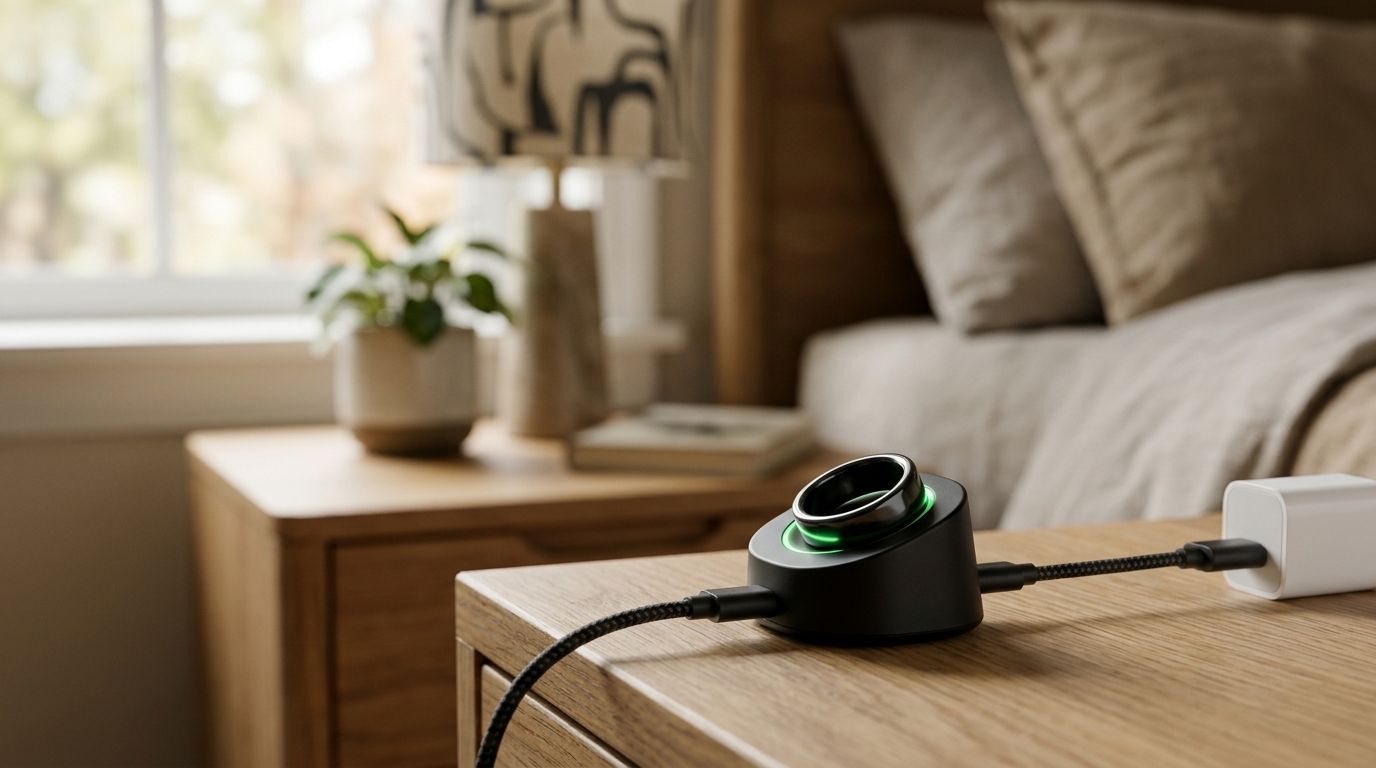
Best overall: Ray-Ban Meta smart glasses for hands-free AI assistance. Best for screenless idea capture: Present Ring AI's pre-launch R1. Best for meeting notes: PLAUD NotePin.
- Best AI wearables 2026: Ray-Ban Meta is the overall pick for hands-free assistance through smart glasses.
- Present Ring AI's pre-launch R1 is the screenless pick for capturing spoken ideas, but its real-world performance is unproven.
- PLAUD NotePin is the better fit when your main job is recording conversations and turning them into notes.
- Choose by the task you need done; these 3 devices are not substitutes for one another.
Why this matters
An AI wearable can listen to a question, capture a thought, or record a conversation. Those jobs overlap, but they do not demand the same device. The best choice depends on what you want to do without reaching for your phone.
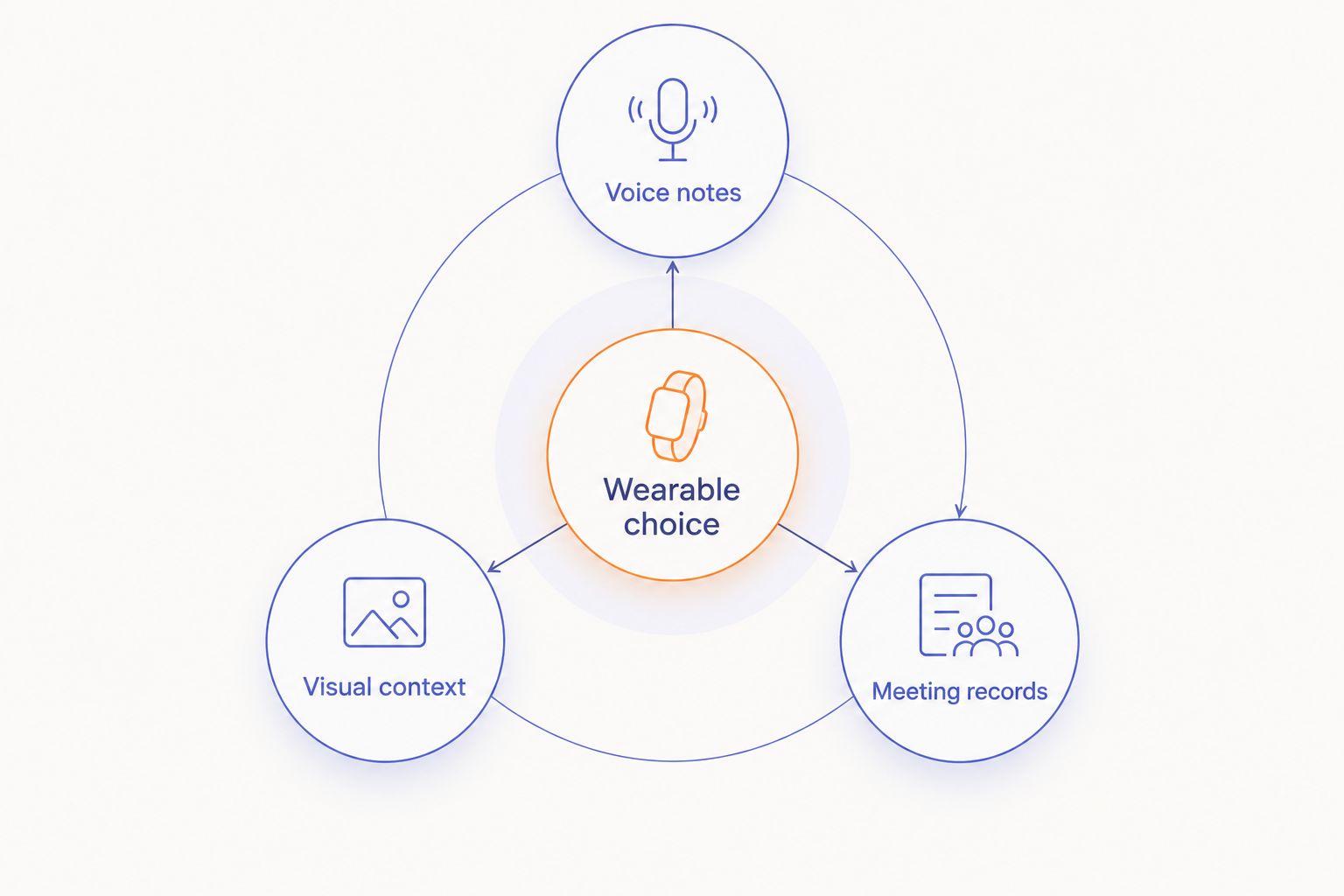
In 2026, this comparison comes down to Voice notes, Visual context, and Meeting records. R1 is designed around the first job. Ray-Ban Meta smart glasses add a camera to voice interaction. PLAUD NotePin focuses on recorded material you can review afterward. Think of this as a Wearable choice, not a single technology race.
The distinction matters most when you consider R1. Present Ring AI's R1 is the screenless pick for spoken ideas, not a proven replacement for devices already in use. It is pre-launch. Its stated design is clear; how it performs in daily use is not established here.
What makes the best AI wearable
Use these criteria before you compare devices. A feature matters only if it helps with your primary task.
- Capture method: Can you speak a passing thought, ask a question, or deliberately record a conversation in the way you need?
- Useful result: Do you need an immediate answer, a transcript to revisit, or notes drawn from a recording?
- Attention cost: Does the device help you stay with what you are doing, or ask you to switch to another interface?
- Review workflow: Consider where the captured material goes and how you will find it later. Do not treat recording as the finished job.
- Recording boundaries: Check how recording starts and stops, and tell other people when a conversation is being recorded.
- Purchase readiness: A pre-launch product is a different decision from a device you can assess through its current documentation and use.
No wearable wins every criterion. Glasses offer visual context that a screenless ring does not. A dedicated recorder is a clearer choice for someone whose work begins with a full conversation rather than a brief idea.
Best AI wearables in 2026 at a glance
| Wearable | Best for | Standout feature | Key limitation |
|---|---|---|---|
| Ray-Ban Meta smart glasses | Hands-free assistance with visual context | Voice interaction alongside a built-in camera | Glasses are a poor fit if you do not want a camera-equipped device on your face |
| Present Ring AI R1 | Screenless capture of spoken ideas | A ring with a built-in microphone, designed to transcribe speech for notes | Pre-launch; everyday transcription and review remain unverified here |
| PLAUD NotePin | Recording conversations for later notes | Wearable audio capture with transcription and summaries | Recorded material still needs review and careful handling |
These are 3 devices for 3 different jobs. Read the sections as a decision tree: ask what you need to capture, then decide how much review you will do afterward.
1. Ray-Ban Meta smart glasses: best for hands-free assistance
Best for: Someone who wants to ask questions by voice and use visual context while keeping their hands free.
Ray-Ban Meta smart glasses combine a camera, microphones, speakers, and voice interaction with Meta AI. That makes them the broadest pick here: you can ask for assistance while the glasses are on, and the camera supports requests tied to what you see. In a 2026 buying guide, they earn the overall slot because they cover more than note capture.
That breadth is also the reason to pause. A camera-equipped pair of glasses is a visible choice in a way a ring or a recording pin is not. If your goal is simply to preserve thoughts, extra ways to interact are not automatically useful. You still need to decide when an image or recording is appropriate around other people.
Ray-Ban Meta smart glasses pros:
- Voice interaction lets you ask for help without holding a phone.
- Camera input adds context that audio-only devices cannot capture.
- Speakers return spoken responses without requiring a screen in your hand.
Ray-Ban Meta smart glasses cons:
- You must want to wear glasses to get their benefit.
- A camera changes the social and privacy considerations around everyday use.
- Their wide range of functions is more than you need for a simple spoken-notes habit.
Choose them when assistance during an activity matters more than maintaining a quiet, note-only routine. If you mainly want to capture an idea and get back to the moment, the overall winner is not necessarily your winner.
Verdict: Buy if hands-free questions and visual context are your main reasons to wear a device. Skip if you only need a place for spoken thoughts.
2. Present Ring AI R1: best for screenless idea capture
Best for: Someone who wants to speak an idea or conversation for note-taking without choosing a wearable screen.
R1 is a pre-launch smart ring with a built-in microphone. Present Ring AI describes it as a way to transcribe spoken ideas and conversations for notes. Its appeal is focused: speak, capture the thought, and return your attention to what is in front of you. It is the 1 screenless ring in this comparison.
That focus gives R1 a distinct place, not a blanket recommendation. Its stated purpose does not establish how accurately it will transcribe speech, how easily you will review notes, or how it will behave in a noisy setting. Check those points when usable product details are available. Do not make a purchase decision on an unverified workflow.
Present Ring AI R1 pros:
- The screenless design fits a preference for fewer visible prompts.
- A microphone built into the ring supports its stated voice-capture purpose.
- The stated use case is specific: spoken ideas and conversations become notes.
Present Ring AI R1 cons:
- R1 is pre-launch, so its daily-use performance is not established here.
- A ring cannot provide the visual context of camera-equipped glasses.
- Recording conversations requires clear boundaries with the people involved.
A screenless interface changes what you give up as well as what you avoid. You do not have a display on the ring to inspect a transcript at the moment of capture. Before choosing R1, find out how you will confirm that a thought was captured and retrieve the resulting note. Those are questions to answer, not features to assume.
Present Ring AI's R1 is the strongest conceptual match for distraction-free voice notes in this list. In 2026, its pre-launch status keeps it from the overall slot. The fit is promising for the stated task; the experience still needs to be judged on the product itself.
Verdict: Wait if you need a wearable now. Consider R1 when its capture and review workflow can be assessed directly.
3. PLAUD NotePin: best for recorded conversations
Best for: Someone whose main task is capturing a conversation and turning the recording into material to review.
PLAUD NotePin is a wearable recorder built around audio capture, transcription, and summaries. It is a more direct match than smart glasses when your starting point is a conversation you intend to revisit. Unlike a fleeting voice prompt, that work creates a record you need to check and handle responsibly.
Do not confuse a summary with an agreed account of a meeting. Read the transcript where wording matters, and confirm any decision or action with the people involved. The device can help you organize what was said; it does not remove your responsibility for the final note.
PLAUD NotePin pros:
- Its recording-first purpose is clear.
- Transcription gives you a way to revisit spoken material.
- Summaries can provide a starting point for reviewing a longer conversation.
PLAUD NotePin cons:
- You must decide when recording is appropriate and make that clear to others.
- Transcripts and summaries still require review.
- It is a less focused choice for someone who wants only to catch passing ideas.
PLAUD NotePin and R1 are the 2 voice-first options here, but they answer different questions. Choose NotePin when you plan to review a recording. Consider R1 when the attraction is speaking a thought through a screenless ring. Neither should be treated as permission to record someone without addressing consent and applicable rules.
Verdict: Buy if your routine centers on recorded conversations and you will review the resulting notes. Skip if the goal is only quick idea capture.
How we ranked the 2026 picks
The ranking follows the criteria above: capture method, useful result, attention cost, review workflow, recording boundaries, and purchase readiness. Ray-Ban Meta smart glasses take the overall position for the range of hands-free tasks they address. R1 takes the screenless idea-capture slot because that is its stated purpose, with a clear pre-launch qualification. PLAUD NotePin takes the conversation-notes slot because recording and reviewing speech are central to its use.
This is a use-case ranking, not a claim that every device was tested side by side. In particular, no real-world R1 transcription result is established here. That limit is part of the verdict, not a footnote to it.
Which AI wearable should you choose?
Choose Ray-Ban Meta smart glasses by default if you want one wearable for hands-free questions and visual context. The camera and voice interface give them the broadest role among these picks, provided you want to wear glasses and are comfortable with the boundaries a camera brings.
Choose PLAUD NotePin instead when recorded conversations are the work. The point is not to ask an assistant a quick question; it is to return to what people said and make useful notes from it.
Choose a different path for a quieter habit. Present Ring AI's R1 is designed for speaking ideas into a screenless ring, but it is pre-launch. If that specific form matters more to you than buying a device now, wait until you can judge the capture and review experience. In 2026, that is the honest screenless verdict.
FAQ
What is the best AI wearable in 2026?
Ray-Ban Meta smart glasses are the overall pick for hands-free assistance with visual context. Choose by task instead if you mainly need conversation notes or screenless idea capture.
What is the best AI wearable for taking voice notes?
Present Ring AI's pre-launch R1 is the screenless pick for spoken ideas and note-taking. Its real-world capture and review workflow still needs direct assessment.
Is R1 better than Ray-Ban Meta smart glasses?
R1 is the more focused choice for someone seeking a screenless voice-note ring; Ray-Ban Meta smart glasses are better suited to hands-free assistance with visual context. R1 is pre-launch, so this is a use-case distinction, not a performance comparison.
Is PLAUD NotePin better for meetings than smart glasses?
PLAUD NotePin is the more direct choice when your main task is recording a conversation for transcription and review. Ray-Ban Meta smart glasses serve a broader hands-free assistance role.
Can an AI wearable replace handwritten meeting notes?
An AI wearable can produce material to review, but you still need to check wording, decisions, and action items. Recording also requires attention to other participants and applicable rules.
Should I wait for the Present Ring AI R1?
Wait if a screenless ring for spoken ideas is your priority and you do not need a device now. R1 is pre-launch, so assess its actual capture and note-review workflow before deciding.
One last thing
The feature that decides whether voice capture becomes useful is retrieval. Before choosing any device, ask how you will find a thought after the conversation ends. If you cannot answer that plainly, another recording method will not fix the note-taking habit.