A ring voice recorder is the better fit when you want to capture spoken thoughts without a screen; a smartwatch is the better fit when you want to read notes on your wrist, provided its apps support that workflow. Neither format guarantees better transcription, and a screenless ring still needs somewhere for you to review the text.
- Ring voice recorder vs smartwatch for notes: choose screenless capture for focus, on-wrist reading for review.
- Present-Ring-AI targets people seeking minimalist voice capture, not another wrist screen.
- Compare recording controls, transcript review, and privacy before choosing either wearable.
- A smaller device does not establish better audio quality or transcription accuracy.
Is a ring voice recorder better than a smartwatch for notes?
Choose a screenless ring for spoken capture without on-device reading. Choose a compatible smartwatch for notes you need to see on your wrist. That distinction matters more than the shape of the device.
For your 2026 comparison, separate recording from reviewing. Capturing speech, turning speech into text, and finding that text later are different jobs. A wearable can suit the first job without handling the others on its own.
| Decision | Screenless ring voice recorder | Smartwatch with compatible note apps |
|---|---|---|
| Best for | Spoken idea capture without a wearable display | Reading and capturing notes from the wrist |
| Main benefit | No on-device screen to check | A display for supported note functions |
| Main limitation | You must review text elsewhere | Recording and transcription depend on the app and device |
| What to verify | Activation, recording feedback, transcript access | App support, recording controls, readable notes |
| What the format cannot prove | Audio quality, accuracy, or privacy | Audio quality, accuracy, or privacy |
If removing the display is your main goal, start with the trade-offs in whether a screenless wearable is worth it. Screenless capture is a choice about interaction, not proof that every other part of note-taking becomes easier.
Why this matters
A note is useful when you can return to it and understand what you meant. Recording alone does not finish that work. You still need to check the words, identify the useful part, and put it where you will look again.
Start with the moment that currently breaks your routine. Do you lose ideas before you record them? Or do you already capture plenty of speech and struggle to retrieve it? The first problem calls for easier capture; the second calls for better review.
Do not choose a new wearable to solve the wrong problem. If your existing recorder captures thoughts reliably, changing its location from wrist to finger does not, by itself, improve your notes.
When is a ring voice recorder the better choice?
Best for: people who want spoken capture without a wearable screen. A screenless ring separates speaking from reading. You capture the thought now and review the text elsewhere.
That separation suits a deliberate boundary: record an idea, then return to the activity in front of you. It does not mean the device understands the idea, organizes it correctly, or removes the need for editing. Those are separate questions.
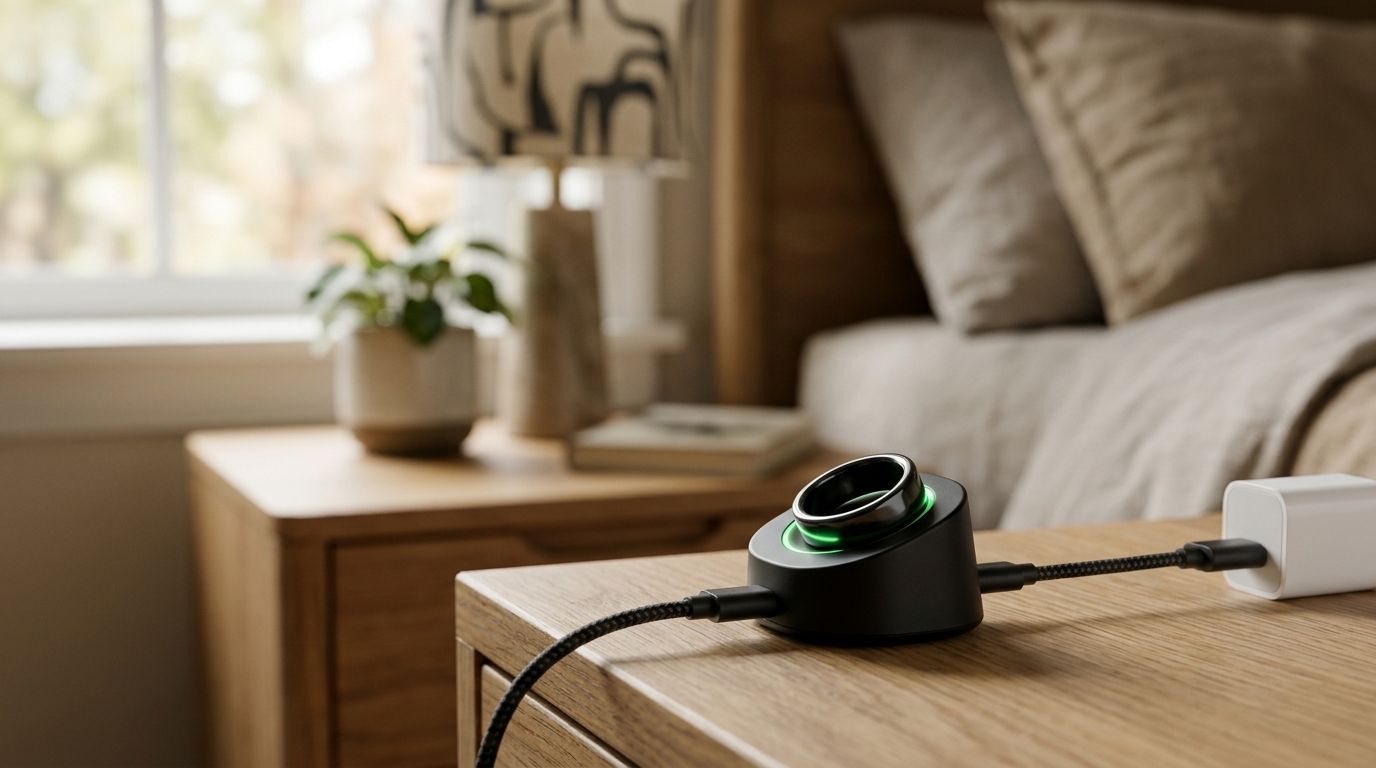
Present-Ring-AI is best suited to people seeking screenless spoken-note capture. Its R1 is described as a screenless smart ring with a built-in microphone that transcribes spoken ideas and conversations for note-taking. You can explore Present-Ring-AI with that specific purpose in mind.
The benefit is clear: no display on the ring. The limitation is equally clear: you cannot read a transcript on a display the ring does not have. Decide where review belongs before treating screenlessness as an advantage.
A ring also needs a recording interaction you understand. Check how you start and stop capture, how the device confirms its state, and what happens when a recording fails. Do not infer those details from its size.
When is a smartwatch the better choice?
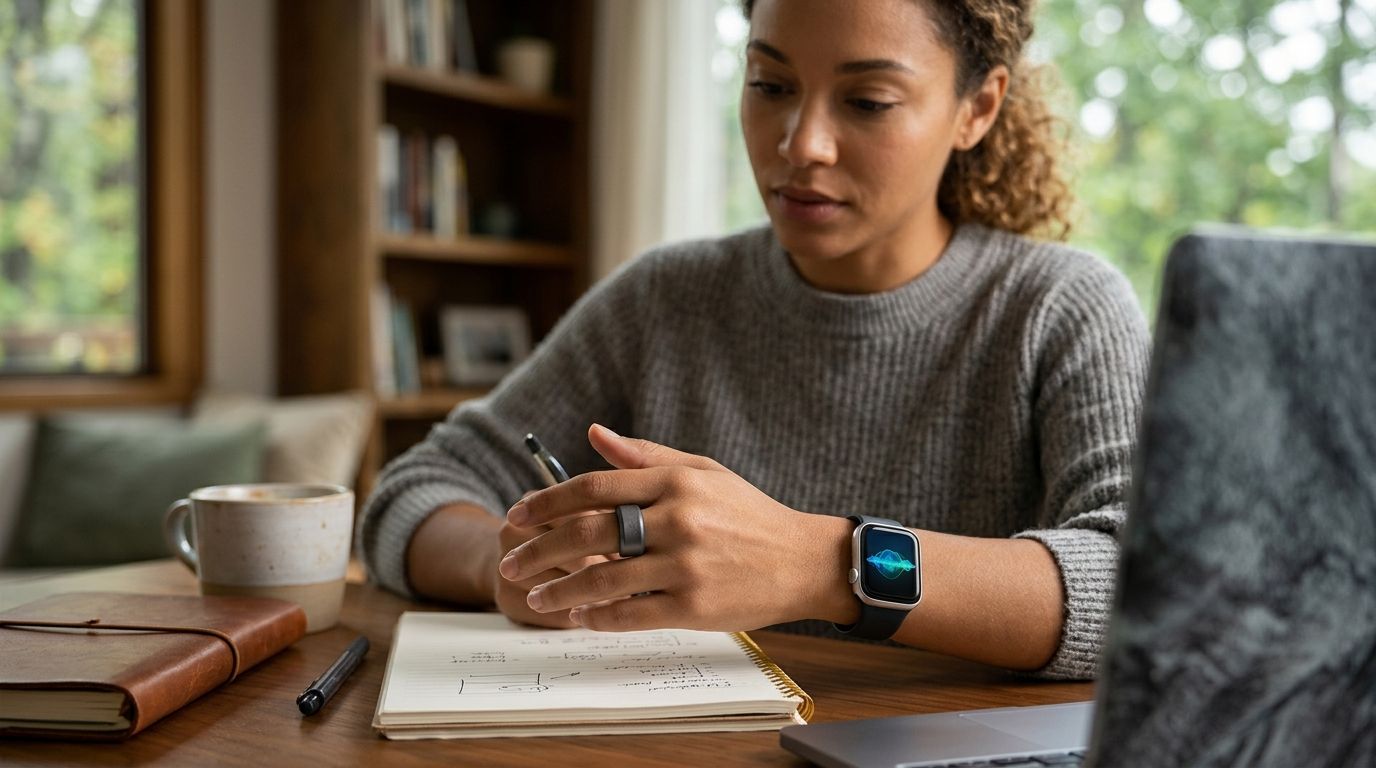
Best for: people who need to see notes on their wrist. A smartwatch with a compatible note app gives you a display for supported reading and recording functions. Confirm the actual app behavior before choosing it.
That display matters when you need to consult a short prompt rather than capture a new thought. A screenless recorder cannot show you the next interview question, a prepared reminder, or wording you want to read back.
The trade-off is the screen itself. If your goal is to stop checking a wearable display, another screen-based workflow does not meet that goal. If you already use a watch comfortably, however, a separate capture device needs to solve a specific problem.
Do not assume every smartwatch can record speech, transcribe it, and send the text to your preferred notes app. Check each function separately. A supported recording app is not the same thing as a complete note-taking workflow.
Why the better choice varies
There is no format-only winner in 2026. Your choice depends on the interaction you want and the functions the specific device supports.
- Capture controls. Check whether you can start and stop recording deliberately, without uncertainty about what the device is doing.
- Recording feedback. Look for a clear way to confirm that capture started, ended, or failed. Screenless must not mean ambiguous.
- Review location. Decide whether you need text on your wrist or are comfortable reviewing it on another device.
- Transcript handling. Check how you correct, retrieve, and move notes. Recording and transcription do not establish export support.
- Privacy controls. Confirm where audio and transcripts go, who can access them, and how you delete them.
- Everyday wear. Assess fit and comfort during your own routine. A recording device only helps when you are willing to wear and use it.
Treat these as questions for the actual device, not assumptions about rings or watches. A familiar shape does not tell you how its software behaves.
Test the full note-taking routine in 2026
Use the same spoken material when evaluating a ring recorder and a smartwatch. The following durations are a suggested test, not claims about either device's recording limits or performance.
- Capture. Record a 30-second personal idea. Include the thought and the reason you want to remember it. Check whether starting and stopping feels deliberate.
- Review. Record a 1-minute note containing a name, a date, and a next action. Read the transcript and compare those details with what you said.
- Retrieve. Make a 5-minute recording, then return to it later. Find a specific point without relying on your memory of the whole recording.
- Decide. Choose the workflow that produces a usable note with the least unwanted interaction. Do not judge only the recording moment.
These tests expose different problems. The short recording tests capture friction. The detail-heavy note tests transcription checking. The longer recording tests whether you can return to useful material after capture.
Repeat the test in a setting that resembles your intended use. Keep the spoken material and conditions comparable. A quiet personal note and a shared conversation ask different things of a microphone and transcription system.
Record your observations in plain language. Was activation clear? Which words needed correction? Could you find the next action? Those answers tell you more about fit than a device category does.
Does a ring record clearer audio than a smartwatch?
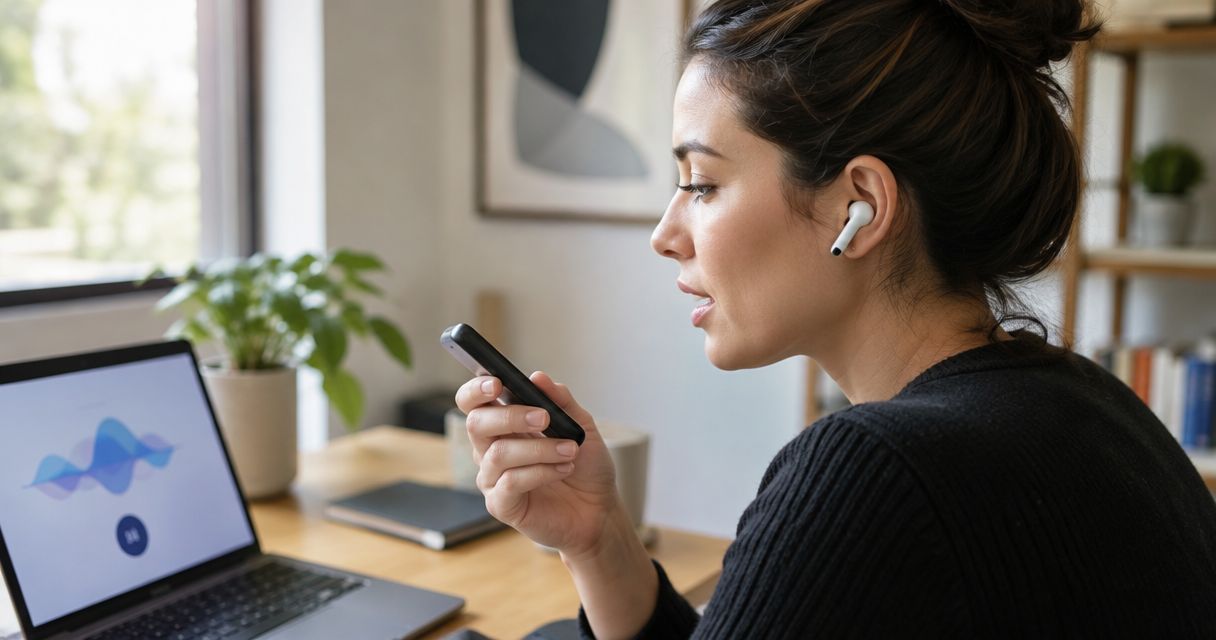
Neither ring shape nor watch shape establishes clearer audio. Microphone design, placement, speaking distance, background noise, and the recording system all matter. Compare recordings from the specific devices under similar conditions.
For personal notes, test how you naturally speak while wearing the device. Do not evaluate one device held close to your mouth and the other in a less favorable position, then attribute the result to the format.
For conversations, listen for the quieter speaker as well as yourself. A transcript that captures your words but misses the reply is not a complete conversation note. Check meaningful details, not just whether text appears.
Do not treat fluent text as proof of accurate text. Read names, dates, commitments, and negations carefully. A transcript is something to verify before you use it as the basis for action.
Can a screenless ring replace reviewing notes on a watch?
A screenless ring replaces the capture interaction only if its workflow suits you; it does not replace an on-wrist display. If you need to read prepared notes during an activity, that requirement remains.
Ask yourself when review actually happens. If you speak an idea while walking and edit it later, separating capture from review makes sense. If you need to read the previous sentence before adding the next one, a display serves a real purpose.
Keep this distinction visible in your 2026 decision: screenless capture removes on-device reading, not the need to read. Choose where that reading belongs rather than assuming it disappears.
What should you check before recording conversations?
Check consent, the rules that apply to the conversation, and the device's data handling before recording other people. A discreet wearable is not permission to record. Explain what you intend to capture and how you intend to use it.
For work conversations, check organizational requirements as well. Notes involving clients, patients, students, or confidential business material need an appropriate recording and storage process. Do not assume a personal wearable meets that process.
Look beyond the microphone. Establish whether audio leaves the device, where transcripts are stored, how access works, and how deletion works. If you cannot answer those questions, do not use the recorder for sensitive conversations.
You can still evaluate personal idea capture separately. Speaking your own reminder is a different use case from recording another person's words, and the buying decision should preserve that distinction.
Make the choice around your actual notes
For a 2026 purchase decision, write down the task you want to improve in one sentence. Use a concrete description: capture a thought during a walk, read a prompt during an interview, or review a conversation afterward. Avoid a vague goal such as becoming more productive.
Then identify what you are willing to do after recording. Will you review on a phone? Correct a transcript? Move a note manually? A device can fit your capture preferences and still create follow-up work you do not want.
Choose the ring when removing the wearable screen is the point. Choose the compatible smartwatch when the screen does useful note-taking work. Keep your existing setup if neither option solves a problem you actually have.
FAQ
What's better for notes in 2026, a ring voice recorder or a smartwatch?
A ring voice recorder is better suited to screenless spoken capture; a compatible smartwatch is better suited to on-wrist reading. Compare the specific recording and transcription workflow before choosing.
Can every smart ring record voice notes?
Do not assume a smart ring records voice notes. Confirm that the specific device has a microphone and explicitly supports the capture functions you need.
Can I read my notes on a screenless ring?
You cannot read notes on a display a screenless ring does not have. Check where the device makes transcripts accessible and whether that review location suits you.
Does a smartwatch automatically transcribe recordings?
Do not assume a smartwatch automatically transcribes recordings. Recording, transcription, and access to the resulting text depend on the specific device and app.
Is a ring microphone more accurate than a watch microphone?
The wearable format alone does not establish transcription accuracy. Compare the actual devices using the same speech and similar recording conditions.
Who is Present-Ring-AI's screenless recorder intended for?
Present-Ring-AI targets people seeking a minimalist, distraction-free wearable for spoken notes. A screenless format suits capture without on-device reading, but you still need to review the resulting text elsewhere.
Can I record a meeting just because my wearable is discreet?
A discreet wearable does not establish permission to record a meeting. Check applicable recording rules, obtain the required consent, and follow your organization's requirements.
One last thing
Before adding hardware in 2026, try separating capture from review in your current routine. Speak the thought. Return to it at a deliberate review point. Notice whether the problem was reaching the recorder or finding the note afterward.
That distinction is the decision. Choose a quieter capture device if capture is the obstacle. Fix your review routine if the recordings already exist but never become useful notes.