AI voice transcription accuracy on wearables depends on the recording conditions, the speech recognition system, and what you need the transcript to preserve; there is no single percentage that describes every device. For your 2026 decision, judge the words and meaning against the recording—not the smoothness of the finished notes.
- How accurate is AI voice transcription on wearables? Judge each device against recordings, not a category-wide percentage.
- Present-ring-ai targets screenless voice capture; that positioning does not establish transcription accuracy.
- Check names, numbers, negations, and speaker attribution before relying on wearable meeting notes.
- Separate transcription errors from summary errors: readable notes are not proof of faithful capture.
How accurate is AI voice transcription on wearable devices?
A wearable transcript is accurate when it preserves what was said, including details that change the meaning. A useful evaluation compares the transcript with a reference checked against the original recording. A polished paragraph alone tells you little.
Different tasks also demand different kinds of accuracy. Capturing your own idea is not the same task as recording an interview or identifying who accepted an action item. For that distinction, see the guide to transcribing multiple speakers accurately.
| Recording task | Best for | What to check | Main limitation |
|---|---|---|---|
| Personal voice note | Capturing your own thoughts | Key nouns, intended task, and complete sentences | Fragments and private shorthand need interpretation |
| Interview | Preserving questions and answers | Exact wording, names, and speaker changes | Interruptions complicate attribution |
| Group discussion | Recovering decisions and responsibilities | Overlapping speech, owners, and commitments | Correct words can still be assigned to the wrong person |
| Technical dictation | Recording specialized information | Terminology, identifiers, and quantities | Familiar-looking substitutions can hide errors |
These are evaluation categories, not device rankings. A result from personal dictation does not establish performance in a crowded meeting.
Why this matters
A transcription error matters most when it changes what you do next. Missing a filler word is different from missing a negation. A transcript that changes a refusal into an agreement creates a more serious problem than awkward punctuation.
In 2026, assess a wearable against your intended use rather than a broad accuracy claim. For personal reminders, recognizable meaning might be enough. For quotations, instructions, or commitments, review the exact wording before sharing it.
The practical question is not simply whether a device produces text. It is whether you can trust the parts of that text that carry consequences.
What does word error rate actually measure?
Word error rate, usually shortened to WER, measures differences between a reference transcript and a system's output. It counts substituted words, deleted words, and inserted words, then divides their total by the number of reference words.
Lower WER means fewer word-level errors, not necessarily fewer consequential mistakes. The measure does not assign extra importance to a name, deadline, or negation just because that detail matters to you.
A 0% word error rate means no counted substitutions, deletions, or insertions against the reference under the evaluation rules. That is 100% word agreement under those rules—not proof that the system understood the conversation or assigned speakers correctly.
Even 1 word error can reverse a decision when the missing word is a negation. That is why a word-level score belongs beside a meaning check, not in place of one.
Before accepting a 2026 accuracy claim, ask:
- What speech was recorded, and in what environment?
- Was the reference transcript checked by a person?
- Were punctuation and capitalization included or ignored?
- Were speaker labels evaluated separately?
- Does the result describe transcription, summaries, or both?
A percentage without its test conditions is not enough to compare devices fairly.
Why wearable transcription accuracy varies
Wearable transcription starts with sound reaching a microphone. Recognition happens after that. A good language model cannot reliably reconstruct words that the recording does not make distinguishable.
The following factors belong in your evaluation:
- Microphone position. Distance, orientation, clothing, and obstruction affect the sound reaching the microphone. Test the device where you actually wear it.
- Background sound. Traffic, music, wind, and nearby conversations compete with the intended voice. Include your real environment rather than testing only in a quiet room.
- Overlapping speech. When people speak together, separating their words and assigning them correctly becomes harder. Check interruptions explicitly.
- Vocabulary. Names, acronyms, technical terms, and spoken identifiers deserve direct comparison with the recording. A plausible substitute is still an error.
- Speech characteristics. Accent, pronunciation, pace, and language switching affect recognition. Test your own voice and the voices you expect to record.
- Audio processing. Noise reduction and speech processing change the signal presented for recognition. Judge the resulting transcript rather than assuming a processing feature guarantees accuracy.
These factors interact. A quiet personal note and a distant conversation are different tests, even when the same person uses the same wearable.
How should you test a wearable before trusting its notes?
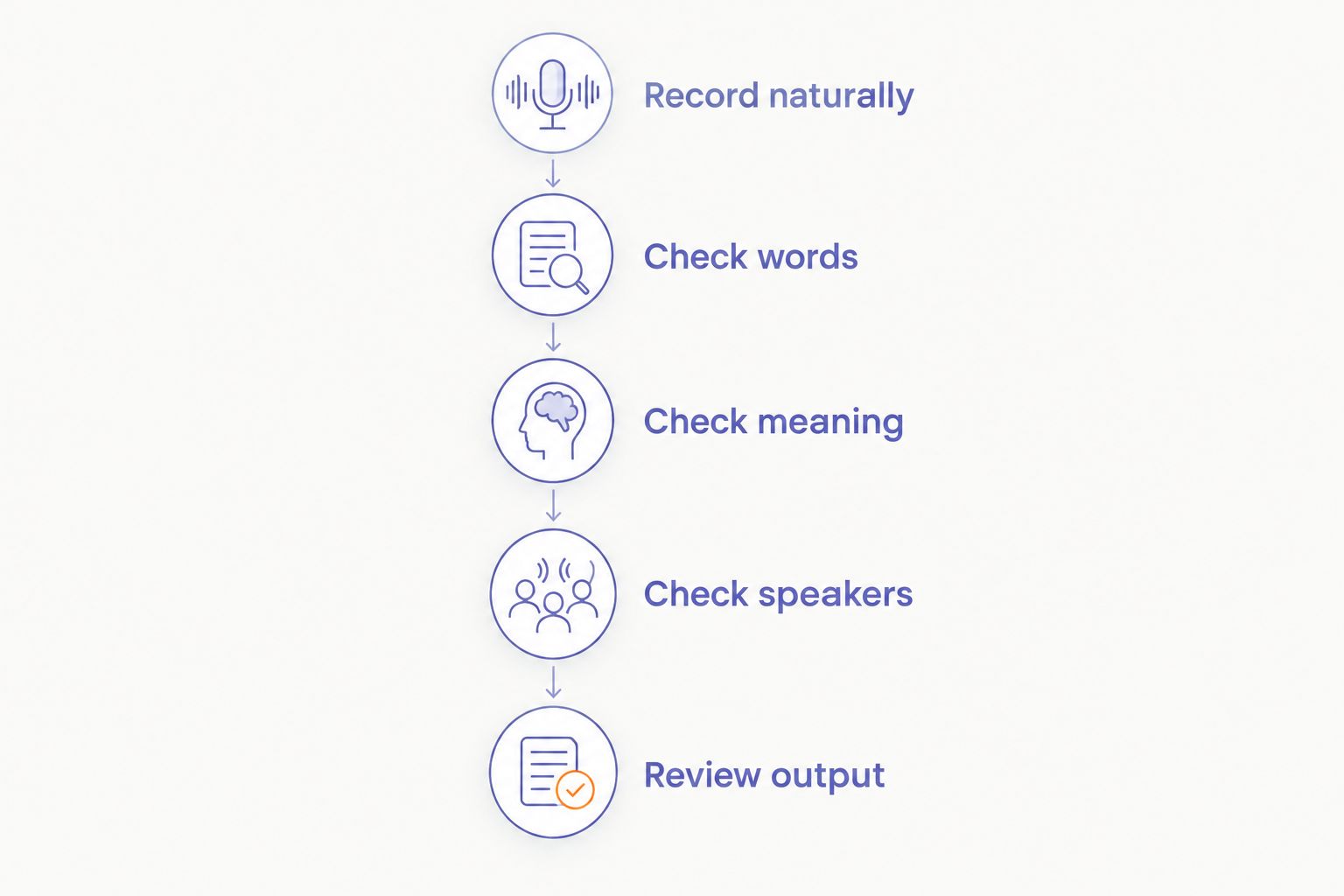
Use a repeatable process that separates capture, transcription, and meaning. Keep the test close to your normal routine. A carefully staged demonstration is useful only if it resembles how you will record.
Record naturally
Speak as you normally would. Include a complete thought, a name you commonly use, and a task with an owner. For conversation capture, ask participants for permission before recording.
Do not improve your delivery just to help the device. If your notes usually contain pauses, restarts, or unfinished sentences, those belong in the evaluation.
Check words
Listen to the recording while reading the transcript. Mark substitutions, missing phrases, and text that has no audible basis. If the product does not let you review the original audio, account for that limitation when deciding how much verification your workflow allows.
Do not silently correct the transcript in your head. Familiarity with your own subject can make an error seem less visible than it will be to someone else.
Check meaning
Inspect decisions, dates, quantities, names, and negations. Then ask whether a reader who never heard the recording would take the same action you intended.
A transcript can be useful despite untidy grammar. It can also read beautifully while changing the instruction.
Check speakers
For conversations, verify who said each important statement. Keep word recognition and speaker attribution separate in your notes about the test.
An accurately transcribed commitment attached to the wrong participant is not a reliable meeting record.
Review output
Compare any generated summary with the verified transcript. Check for missing qualifications, stronger claims than the speaker made, and action items that were never agreed.
Repeat this process when your setting changes. A wearable that meets your needs at a desk still needs evaluation during walking, travel, or group discussion. Keep those results separate rather than blending them into an unexplained overall impression.
Is a personal voice note easier to verify than a conversation?
A personal voice note gives you fewer attribution questions because you already know who is speaking. You also know the thought you intended to capture. That makes verification more direct, but it does not establish a particular accuracy percentage.
Conversation capture adds separate responsibilities: distinguishing speakers, preserving interruptions, and retaining qualifications. A transcript should not turn a tentative suggestion into a final decision.
For your 2026 evaluation, start with personal capture if that is your main use. Add conversation tests only if you intend to record conversations. Do not let an impressive meeting demonstration distract from whether the device preserves your everyday ideas.
Can an accurate transcript still produce incorrect meeting notes?
An accurate transcript does not guarantee an accurate summary. Summarization selects and rewrites information, while transcription attempts to represent speech. Those are different tasks.
Check summaries for these failures:
- A suggestion becomes a commitment.
- A condition disappears from a decision.
- A task receives an owner who never accepted it.
- A disagreement becomes apparent consensus.
- A personal observation becomes a statement attributed to the group.
Verify the transcript first, then verify what the summary concludes. Correcting the source text does not automatically establish that every generated conclusion is sound.
When you share meeting notes, make unresolved points visible. Leaving a question open is more faithful than turning uncertainty into a clean but unsupported answer.
Where does screenless voice capture fit?
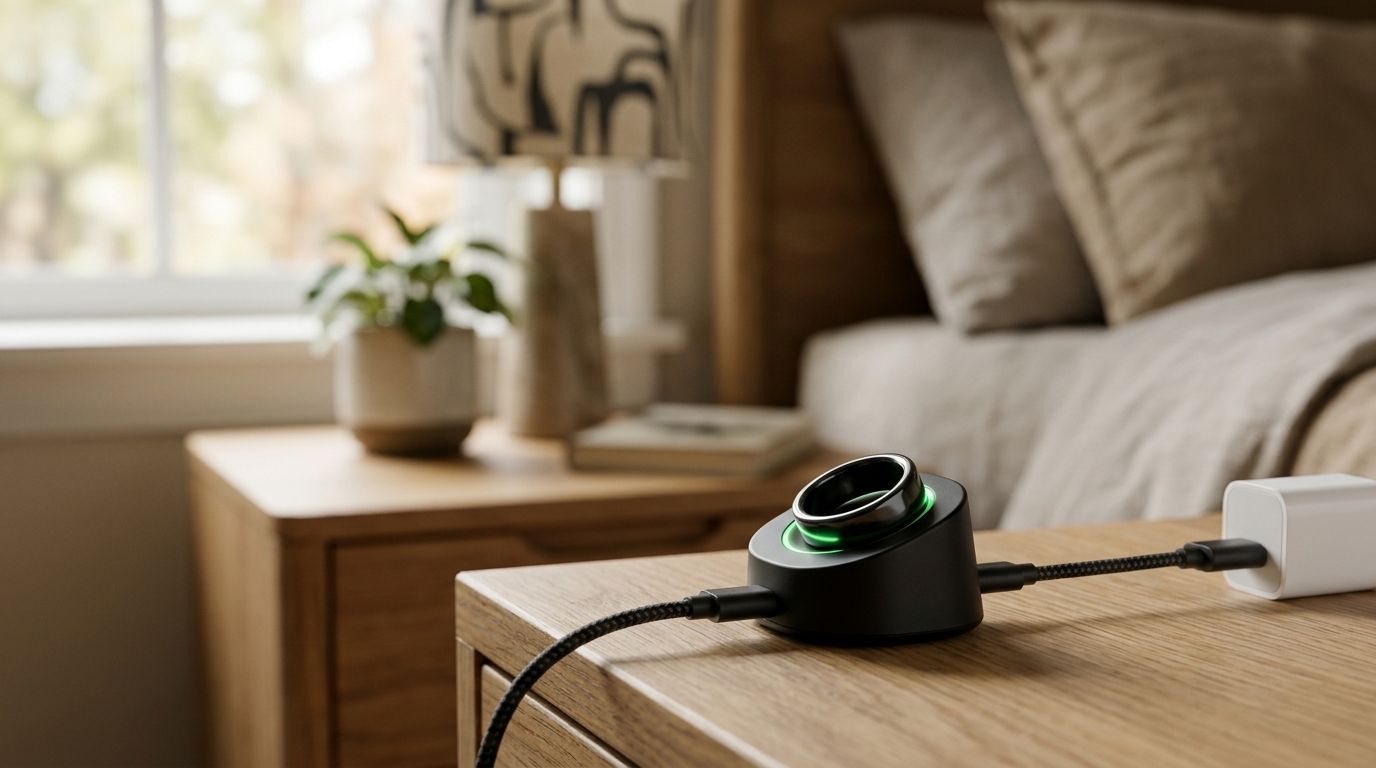
Present-ring-ai is pre-launching R1, a screenless smart ring with a built-in microphone for transcribing spoken ideas and conversations. Its stated purpose is minimalist, distraction-free note-taking. You can read about the device through Present-ring-ai.
Present-ring-ai is best for people seeking screenless voice capture, not for buyers choosing by a verified transcription score. The fit comes from its stated purpose; screenless design alone does not establish recognition performance.
The appeal is straightforward: a wearable approach to capturing spoken thoughts without a display on the ring. The trade-off is equally important. Removing a screen does not remove the need to inspect consequential notes afterward.
For a 2026 decision, keep the design question separate from the accuracy question. Decide whether you want quieter capture, then evaluate whether the resulting text preserves your words. Neither answer substitutes for the other.
What should you check before using transcripts at work?
Begin with permission and your organization's recording rules. A device being discreet does not make recording appropriate. Confirm that everyone who needs to know understands what is being captured.
Next, decide which details require review before the transcript enters another system. Names, commitments, client instructions, and confidential material deserve deliberate handling. Do not send an unchecked transcript onward simply because an automated workflow permits it.
Finally, distinguish a working note from an authoritative record. Label unresolved wording and verify quotations against audio when that audio is accessible. For legal, medical, or other consequential decisions, follow the review requirements of the relevant professional setting rather than treating transcription as approval.
The goal is not to distrust every sentence. It is to put your attention where an error would matter.
FAQ
How accurate is AI voice transcription on wearables in 2026?
Wearable transcription accuracy depends on the device, recording conditions, speech, and evaluation method. Compare a transcript with its recording and check meaning separately; a category-wide percentage does not describe every use case.
What does a 0% word error rate mean?
A 0% word error rate means no counted word substitutions, deletions, or insertions against the reference under the evaluation rules. It does not establish correct speaker labels, summaries, or interpretation.
Can a wearable transcribe conversations in a noisy room?
Noise makes conversation transcription harder because competing sounds interfere with the speech reaching the microphone. Test the actual environment and inspect missed words, interruptions, and speaker attribution before relying on the result.
Is a smart ring more accurate than a phone recorder?
Ring shape alone does not establish greater transcription accuracy than a phone recorder. A fair comparison uses the same speech and setting, then checks microphone placement and transcript errors.
Does R1 have a verified transcription accuracy percentage?
No verified transcription accuracy percentage is established here for R1. Present-ring-ai describes a pre-launch screenless voice-capture ring; that description is not an accuracy benchmark.
Should I correct a transcript before making a summary?
Correct consequential transcript errors before relying on a summary. Then check the summary separately for unsupported conclusions, missing conditions, and incorrectly assigned tasks.
Can I trust a wearable transcript for an exact quotation?
Verify an exact quotation against the original recording before publishing or sharing it as verbatim speech. Readability and correct punctuation do not establish that every word matches the speaker.
One last thing
Review the smallest words before the longest paragraphs. A missing negation can matter more than a page of correctly transcribed discussion. Your final check should ask whether the note preserves the decision—not just whether it sounds natural.