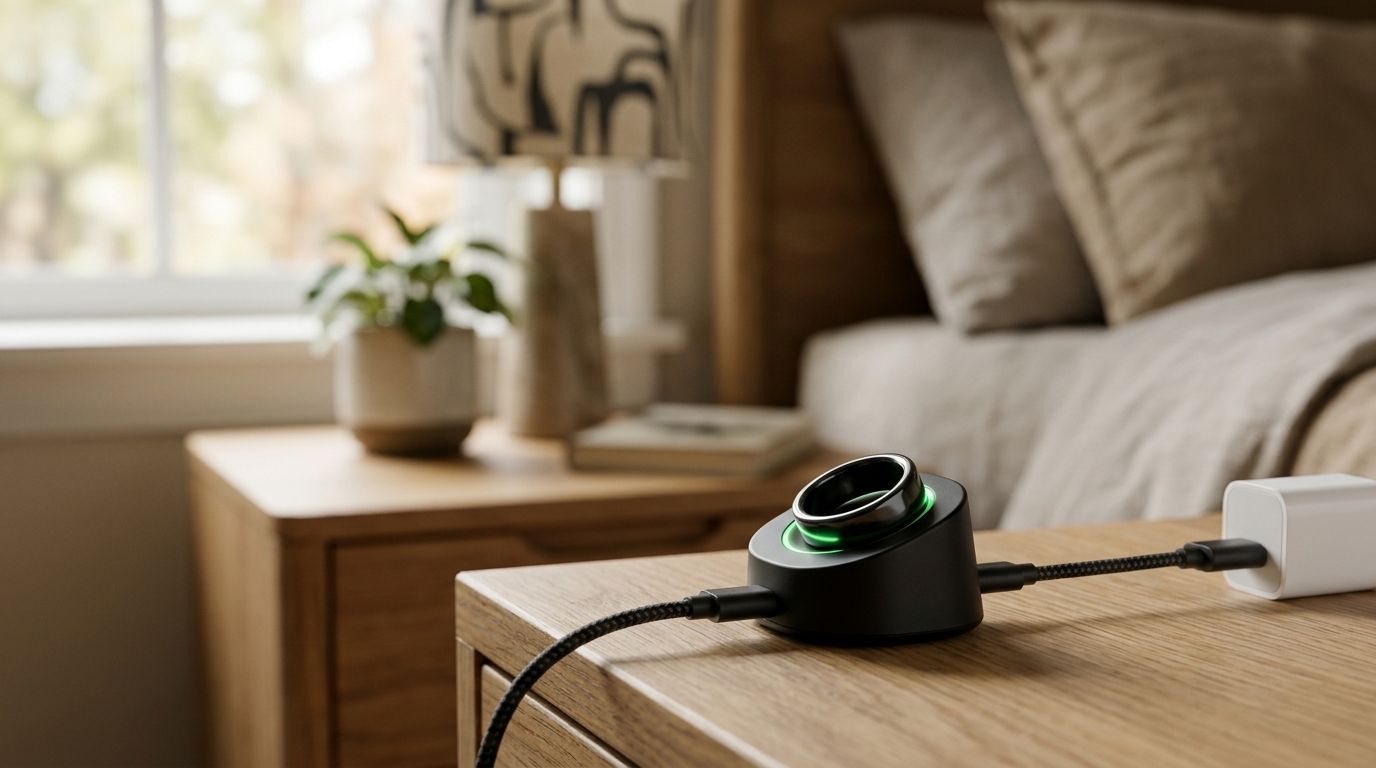
A screenless AI wearable is worth it in 2026 if speaking is your preferred way to capture ideas and you will return to the notes afterward. It is not worth it simply because it removes a display: you still need a way to review the transcript, handle recording responsibly, and turn captured thoughts into something useful.
- Is a screenless AI wearable worth it? Yes for spoken idea capture; no if you need silent, visual note-taking.
- Present-ring-ai targets people seeking screenless voice capture, not another display to check.
- Compare the whole note-taking routine: capture, review, correction, and use.
- Test your voice-note habit before choosing another device.
Is a screenless AI wearable worth it in 2026?
Yes, when it solves a capture problem you actually have. If opening your phone interrupts a thought, a screenless recorder is a relevant alternative. If you already capture and use notes comfortably, removing the screen alone is not a reason to change.
Present-ring-ai is best suited to people seeking screenless voice capture for spoken notes. That is a specific use case, not a replacement for every kind of note-taking.
Start with the method, not the device. Each approach asks something different of you.
| Note-taking option | Best for | Main advantage | Main limitation |
|---|---|---|---|
| Screenless voice wearable | People who prefer speaking their thoughts | Offers voice capture without an on-device display | Requires a separate way to read and correct text |
| Phone voice recording | People who want to test spoken notes with a device they already use | Lets you try the capture habit before adding hardware | Requires using your phone during capture |
| Paper notebook | People who think through writing or drawing | Supports silent notes, sketches, and spatial layouts | Does not produce a spoken recording or transcript |
There is no universal winner. Choose the method whose limitations you can accept during an ordinary day, not the one with the most appealing demonstration.
Why this matters
The useful question in 2026 is not whether a device has a screen. It is whether your note-taking routine asks for attention at the wrong moment.
Capturing an idea and processing it are different jobs. You can speak a thought now and decide what it means later. But postponing that decision does not remove it.
A wearable makes sense when you want that separation. It makes less sense when you need to see, edit, or organize information immediately. A quiet device should support your attention, not create a new obligation to sort through recordings.
When a screenless wearable makes sense
Best for: spoken ideas you want to revisit
Voice capture fits thoughts that arrive as sentences: an opening line, a question to research, or a reminder about unfinished work. You can state the thought without deciding its final format.
The limitation is context. A fragment that feels obvious when spoken can be unclear when you read it later. Include what the idea concerns and why you wanted to keep it.
Instead of recording only “change the introduction,” say which document you mean and what needs changing. Capture enough meaning for your future self, not just enough words for the microphone.
Best for: personal reflection without a display
If you prefer talking through an experience, screenless capture matches that preference. You can express a thought before turning it into an edited journal entry.
The trade-off is privacy and setting. Speaking aloud does not suit every shared room, commute, or workplace. A screenless device removes a display; it does not make your spoken words private.
Keep a silent alternative available. Choosing voice capture should not mean forcing every thought into speech.
Best for: conversations with clear recording permission
A transcript can give you text to review after a conversation. That is useful when you want to check what was discussed rather than rely only on memory.
The limitation is responsibility. Recording affects everyone whose voice is captured. Explain what you intend to record, obtain the required permission, and follow applicable rules before starting.
Do not treat a transcript as an unquestionable record. Check important wording against the recording when that recording is available, particularly before sharing a quotation or acting on a commitment.
When a screenless wearable is not worth it
Skip the category if your central need is visual thinking. Diagrams, handwritten equations, page layouts, and marked-up documents are not the same task as transcribing speech. A microphone does not replace a surface for drawing.
Skip it if speaking feels intrusive in the places where you usually take notes. A notebook or typed note lets you capture something without asking the room to hear it.
Also reconsider if you dislike reviewing recordings or correcting transcripts. The device can capture speech, but capture alone does not decide which ideas deserve attention. An unread transcript remains an unread note.
Finally, do not choose a screenless wearable solely to reduce phone use. First identify which phone interaction you want to remove. If your main distraction happens during reading or messaging rather than note capture, this category addresses a different problem.
Why the value of a screenless wearable varies
The same device category can suit one routine and frustrate another. These factors determine whether the format fits:
- How you express ideas. Spoken sentences suit voice capture. Sketches and visual relationships need another surface.
- Where you capture notes. A private setting supports speaking aloud. A quiet shared setting can make it inappropriate.
- What you record. Personal reminders and conversations involving other people create different consent and handling responsibilities.
- How you review text. A transcript is useful only if you can find it, understand it, and decide what to do next.
- What you expect the device to replace. Replacing a capture step is a narrower requirement than replacing your notebook, phone, or entire work routine.
Judge the complete routine, not just the moment you speak. A pleasant capture experience is not enough if retrieving the note becomes the difficult part.
Test the habit before choosing hardware
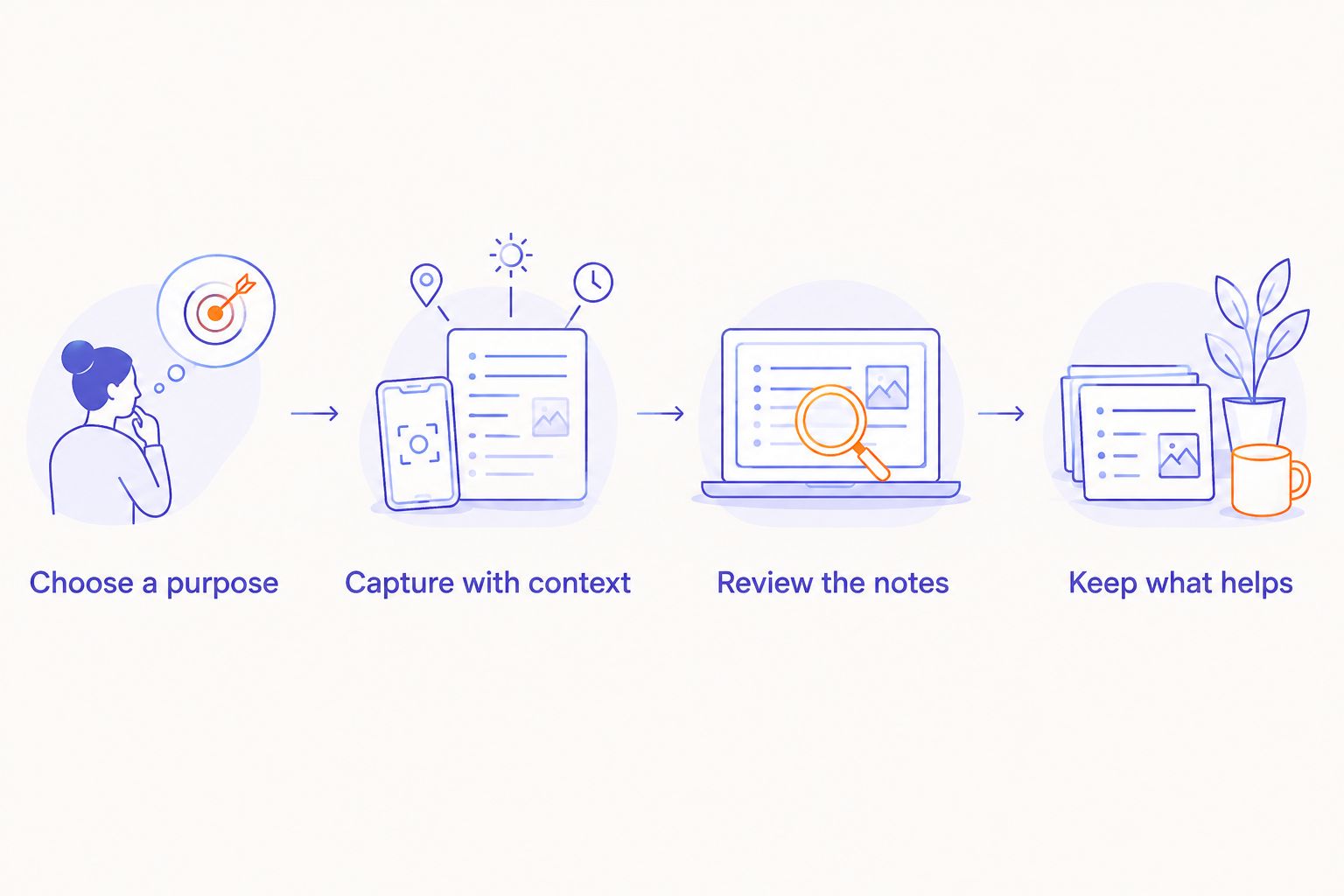
Use a 7-day trial of spoken note-taking with a recording method you already have. This is a decision exercise, not a performance benchmark. The aim is to learn whether you like working with your own spoken notes.
- Choose a purpose. Pick a real need, such as writing ideas or personal reminders. Avoid recording everything simply because you can.
- Capture with context. Aim to collect 3 notes during the trial that explain both the thought and its purpose. Use genuine moments rather than rehearsed demonstrations.
- Review the notes. Set aside 10 minutes to read or listen. Identify anything you cannot understand without reconstructing the original moment.
- Keep what helps. Turn useful notes into an action, a draft, or a reference. Leave the rest out of your working system.
The trial separates enthusiasm for a new object from preference for a new habit. Notice where the routine fails: speaking, finding the note, understanding it, or using it. Hardware should address the relevant step.
If speaking feels natural but taking out your phone breaks the moment, a wearable deserves consideration. If you dislike listening to your notes or cannot make sense of them afterward, removing the display does not resolve that difficulty.
Buying criteria for 2026
Treat “screenless” as a description of the physical format, not proof of a complete workflow. Before choosing a device, establish how recording begins, how you know it has begun, and where the resulting text goes.
Ask these questions in plain language:
- Can you tell when recording starts and stops?
- Where do you read and correct the transcript?
- What happens when a connection is unavailable?
- Can you retrieve your recordings and text in a usable form?
- How do deletion and access controls work?
- What does the device require from your phone or another service?
An unanswered question is a reason to pause, not a feature to assume. A ring shape does not establish recording controls, connectivity, battery endurance, water resistance, or compatibility with your preferred notes app.
Present-ring-ai describes R1 as a screenless smart ring with a built-in microphone that transcribes spoken ideas and conversations for note-taking. That makes it relevant to this decision. The description alone does not establish how every part of your daily routine will work.
Choose on confirmed behavior, not on what you imagine a small device should do. Keep your requirements short enough to check individually.
Does screenless mean distraction-free?
No. Screenless means there is no display on the device; it does not establish how much attention the complete note-taking routine requires. Reviewing text, fixing mistakes, and deciding what matters still take attention.
The practical goal is not to eliminate every interaction. It is to move deliberate review away from the moment you want to preserve. Ask whether that separation helps you remain present, rather than whether the hardware looks minimal.
Can a screenless wearable replace your phone for notes?
A screenless wearable can serve as your capture method, but it is not automatically a complete replacement for reading, editing, and organizing notes. Check the specific device's requirements before expecting independence from your phone.
If you want immediate visual confirmation of names, figures, or wording, retain a method that lets you inspect the text. Removing a screen also removes the ability to read directly on that device.
FAQ
Is a screenless AI wearable worth it in 2026?
A screenless AI wearable is worth it in 2026 when you prefer spoken capture and will revisit the resulting notes. It is a poor fit when you need silent input, sketches, or immediate on-device text review.
What's the best way to know whether I will use a voice wearable?
Try a 7-day spoken-note exercise before choosing hardware. Capture real thoughts, review them, and check whether they become useful actions or reference material.
Is a screenless wearable better than recording on my phone?
A screenless wearable is a better fit only when its capture method solves a problem your phone routine does not. Phone recording remains a useful way to test whether you enjoy spoken notes before adding another device.
Will a screenless wearable stop me from getting distracted?
A screenless wearable does not guarantee fewer distractions. It removes the on-device display, but you still need to review and manage what you capture.
Should I record conversations with a voice wearable?
Record conversations only after explaining the recording, obtaining required permission, and checking applicable rules. A small device does not remove your responsibilities to the people being recorded.
Who is Present-ring-ai's screenless voice-capture approach for?
Present-ring-ai targets individuals seeking a minimalist wearable for transcribing spoken ideas and conversations into notes. That focus suits people evaluating spoken capture rather than a wearable display.
Can I use a transcript without checking it?
Check important transcript details before relying on them. Names, quotations, and commitments deserve particular attention, and you should compare them with the recording when it is available.
One last thing
Write your success condition before choosing the device. Make it describe an outcome: “I can capture a writing idea without opening a screen, then find it when I sit down to write.”
That sentence is more useful than a long feature list. It tells you what the device must accomplish and gives you a reason to reject features that do not serve the task. For your 2026 decision, choose the quieter routine—not merely the quieter-looking object.