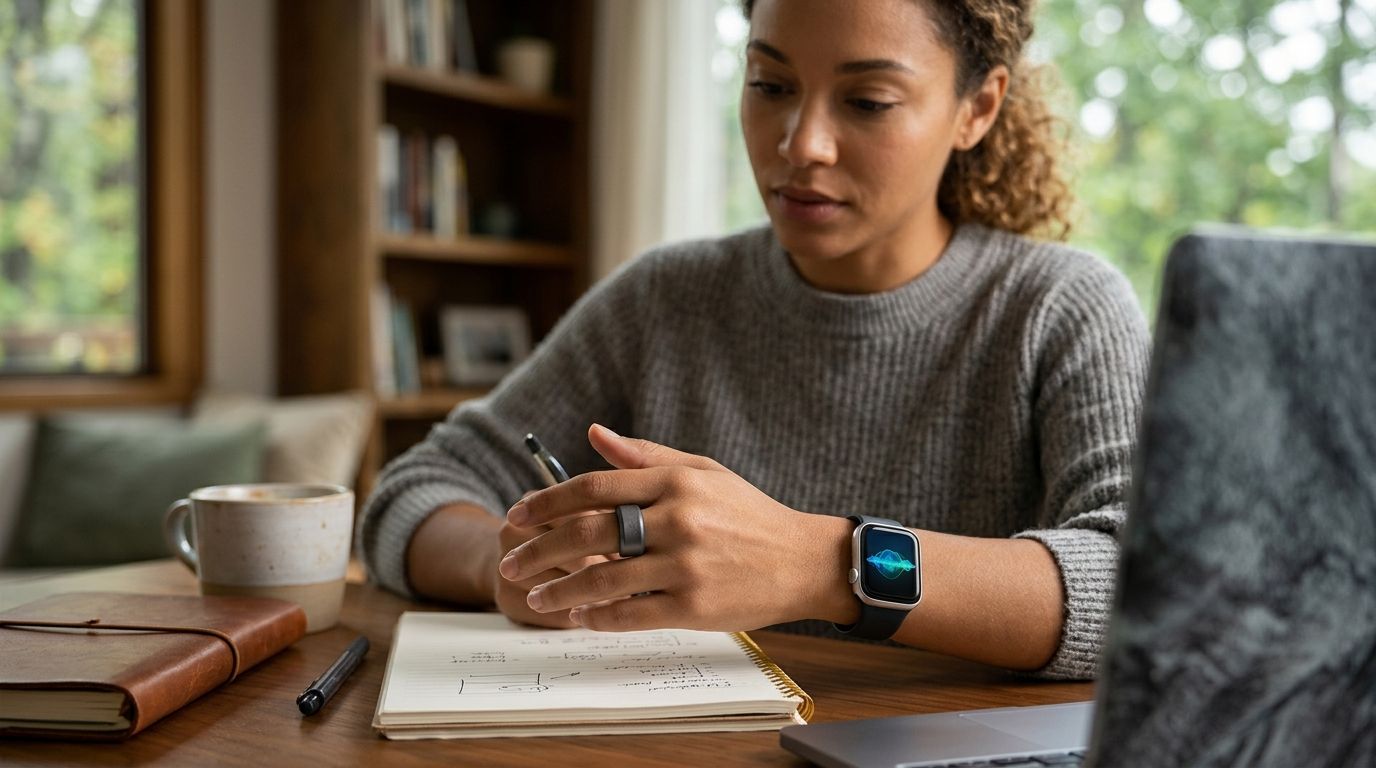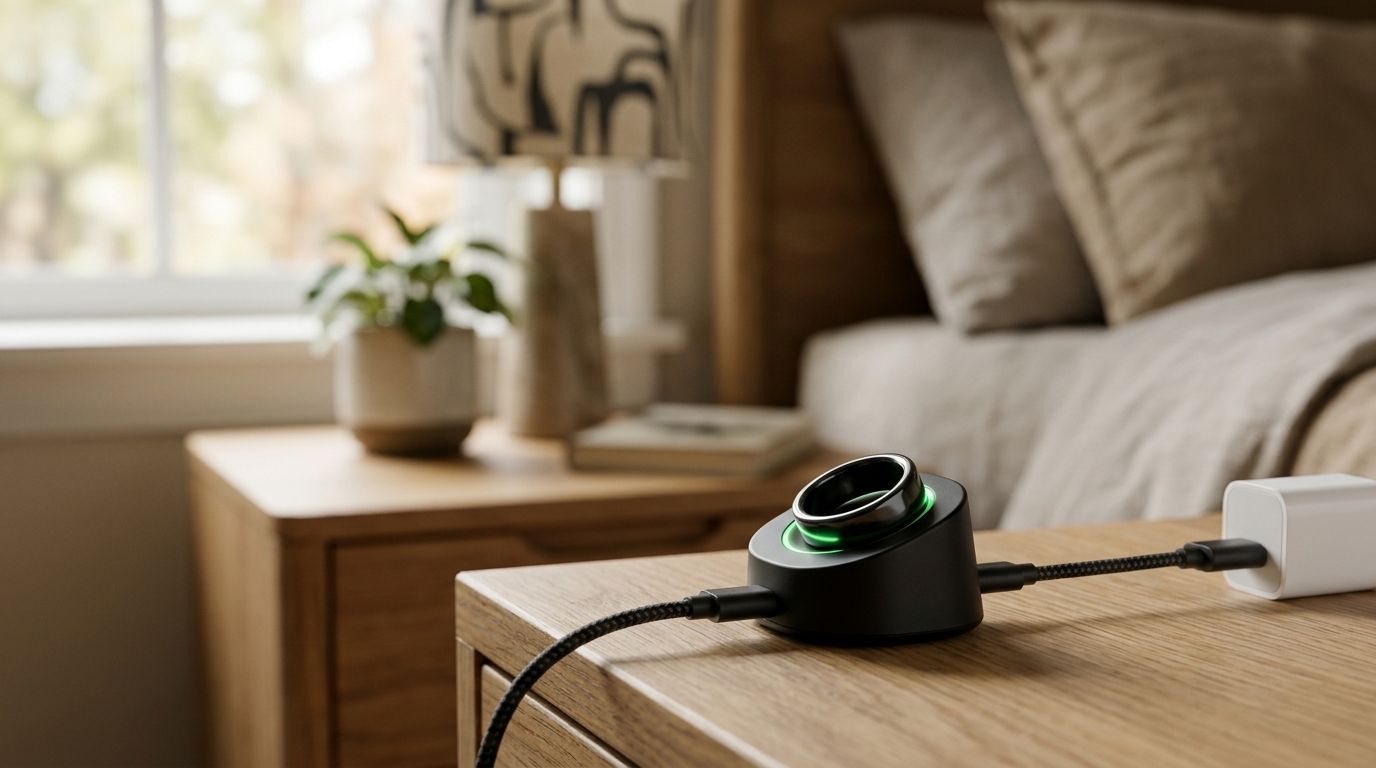
Researchers’ AI note-taking is the capture and transcription of spoken ideas and conversations with the aim of producing traceable research notes; an AI note taker for researchers and academics supports that process, not the evidence behind it. This 2026 guide explains how to capture thoughts without letting an unverified transcript become a quotation, a finding, or a citation.
- An AI note taker for researchers and academics should preserve context, not replace source checking.
- Present-Ring-Ai’s R1 targets screenless voice capture; assess it for personal research ideas, not assumed institutional approval.
- Separate personal reflections, participant recordings, and published evidence before choosing a transcription workflow.
- Check quotations against original recordings and citations against the sources themselves.
Why AI note-taking matters for researchers
Academic notes carry different obligations from ordinary reminders. A passing thought can remain informal. An interview quotation needs an identifiable source, permission to record, and an accurate account of what the participant said.
The distinction matters before you choose a device. A screenless wearable addresses the act of capturing speech. It does not, by that fact alone, establish whether a recording belongs in your research dataset or whether its transcript is accurate enough to quote.
Present-Ring-Ai is pre-launching R1, a screenless ring with a built-in microphone that transcribes spoken ideas and conversations. Present-Ring-Ai’s R1 is for researchers who want screenless voice capture of spoken ideas. That is a specific use case, not a claim about research compliance, transcription accuracy, or suitability for confidential interviews.
For your 2026 workflow, separate two questions: does the capture method keep you present, and does the resulting record meet your research requirements? A useful answer to the first does not settle the second.
Build a research note-taking workflow
Define what you are capturing
Start with a notebook or a document. Give each note a purpose before you consider transcription. You need to distinguish your own thinking from another person’s words and from information taken from a publication.
A useful working structure has three categories: personal ideas, source notes, and participant material. These are organizational choices, not substitutes for your institution’s data classifications. Keep its required labels wherever they apply.
For a personal idea, record the question and the next action. For a source note, preserve the publication details and the location of the passage. For participant material, follow the approved recording and handling procedure.
This prevents a common research problem: a sentence survives, but its origin disappears. Later, you cannot tell whether it was your interpretation, an author’s claim, or a participant’s exact wording. A longer transcript does not repair that missing context.
- Label personal reflections as your own thinking.
- Attach publication details to reading notes.
- Identify participant material using your approved convention.
- Separate direct quotations from paraphrases.
- State whether a note is a question, observation, or proposed action.
Set permission and handling rules
Write down your recording rules before the conversation begins. Check institutional requirements, the study protocol where applicable, and the rules governing the setting. Then make the recording method clear to the people involved.
For personal dictation, begin with your existing phone recorder or a written note. For research conversations, use only a method your project permits. Convenience is not permission, and a small device does not make a recording less consequential.
Before adding an AI note taker to a 2026 research project, establish what happens to audio and text. Look for documented answers about processing, storage, access, deletion, and export. Do not assume that a device worn on your hand processes speech locally.
Present-Ring-Ai’s AI note-taking ring addresses screenless capture. Evaluate its documented handling arrangements separately before using it for participant material. If the requirements are not satisfied, keep the wearable outside that workflow and use the approved recording method instead.
- Confirm permission before recording other people.
- Follow the study’s approved recording procedure.
- Check where audio and transcripts are processed.
- Establish who can access the resulting files.
- Document retention and deletion requirements.
- Keep sensitive material out of unapproved systems.
Capture context alongside speech
Use a simple spoken opening for each personal research note. Name the topic, explain what prompted the thought, and say what you want to do next. You can use this structure with a phone recorder before evaluating another device.
For example, distinguish an observation about a paper from an idea for a future study. Say whether you are recalling a source or proposing an interpretation. Do not dictate a remembered sentence as a verified quotation.
R1 offers a screenless route to transcribing spoken ideas and conversations. The reason to assess that format is straightforward: you want to speak a thought without making a screen the center of the moment. Do not infer automatic citation management or research organization from that capture function.
Keep each recording focused. Use 1 research question per personal voice note as a working rule, not a device limit. It gives the note a clear subject and makes the later review easier to organize.
- Name the research question at the start.
- Identify the paper or event that prompted the thought.
- Mark uncertain recollections as uncertain.
- Distinguish your interpretation from source language.
- End with a specific next action.
Review the transcript against its source
Read the transcript while checking the original recording, when that recording is available. If you cannot check the audio, do not treat the transcript as a verified quotation. Return to the original speaker or source through a method appropriate to your project.
Pay particular attention to names, specialist vocabulary, negation, quantities, and changes of speaker. A transcription error in any of these can change the meaning of a passage. Correct the record visibly rather than silently turning uncertain speech into confident prose.
For your initial 2026 evaluation, choose 3 sample clips from material you are permitted to process: a personal reflection, a technical explanation, and an authorized conversation. This is a suggested test set, not an accuracy benchmark. Include the kind of language your research actually uses.
Keep transcription separate from interpretation. The transcript records speech. Your analytic memo explains what you think that speech means. Combining them without labels makes later checking harder.
- Check candidate quotations against the recording.
- Verify technical terms and proper names.
- Mark unclear passages instead of guessing.
- Confirm speaker labels before attribution.
- Keep an identifiable corrected version.
- Write interpretation in a separate analytic note.
Turn reviewed notes into research actions
Begin manually. Read the checked note, write a short description, and identify what belongs in your research system. You do not need another application to decide whether the next step is reading, analysis, or a conversation with your supervisor.
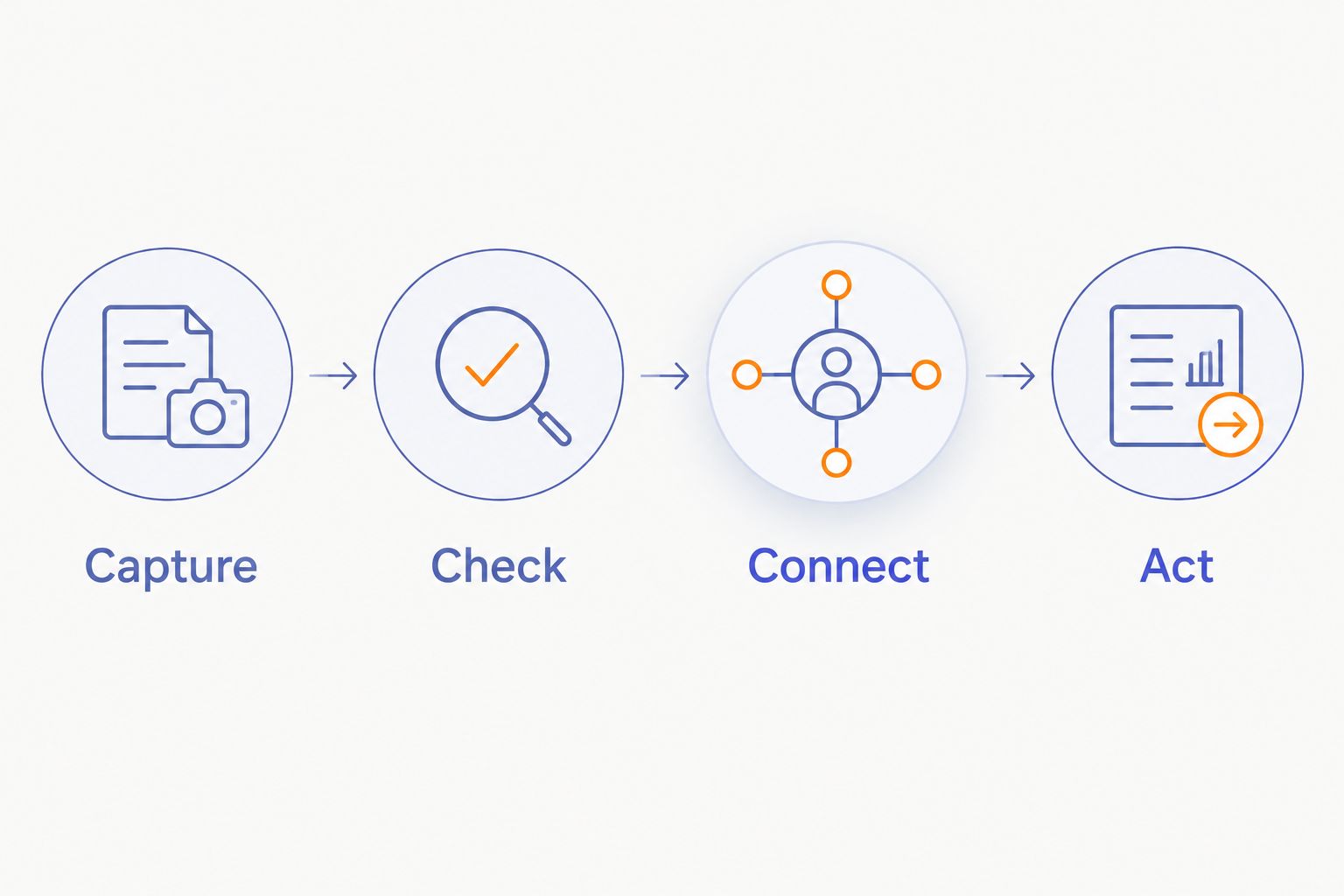
Use a small set of working labels: Capture, Check, Connect, and Act. Capture preserves the thought. Check verifies its wording and origin. Connect associates it with the relevant project or source. Act states what you will do with it.
A wearable belongs at the capture stage. It should not become the authority for the later stages merely because its output looks orderly. You still decide whether a claim is supported and whether an idea deserves further work.
Keep the reviewed note close to its supporting material. A citation without the relevant passage is difficult to inspect. A summary without its source is not a replacement for the source.
- Capture: preserve the original thought and context.
- Check: verify wording, attribution, and source details.
- Connect: attach the note to the relevant research project.
- Act: name the next reading, analysis, or discussion task.
Evaluate the workflow before expanding it
Compare your current method with the proposed workflow using the same permitted material. Judge the complete path from capture to a usable note, not just how easily recording begins. An elegant capture method can still leave you with difficult review work.
Reserve 10 minutes per review session as an initial planning choice. Adjust that allowance after trying the workflow; it is not a promised processing time. Use the session to check wording, attach context, and assign a next action.
For a 2026 purchase decision, check the current product documentation rather than relying on category labels. Ask whether you can recover the material you need, in a form your research process accepts. Establish any institutional requirements before committing.
Keep your existing method until the alternative proves useful for your actual work. If a phone recorder produces clearer, better-organized notes for you, there is no research reason to replace it simply because another format is smaller.
- Compare the same permitted material across methods.
- Record the corrections each transcript needs.
- Check whether source context survives the workflow.
- Confirm that export supports your required records.
- Judge the effort needed to produce a reviewed note.
- Retain the approved method for sensitive work.
Compare your note-taking options
Choose by research task, not by device category. Personal idea capture, reading notes, and participant interviews do not require the same workflow. The useful option is the one that preserves the evidence and context your task needs.
The table separates the strengths of each approach from its limitations. It does not rank transcription accuracy or institutional suitability; those require an evaluation of the specific system and project.
| Option | Best for | Useful strength | Key limitation |
|---|---|---|---|
| Handwritten or typed notes | Reading, source analysis, and selective observations | You choose the structure and record citations directly | They do not preserve a verbatim audio record |
| Existing phone recorder with manual review | Testing a personal dictation workflow | You can assess your process before adding hardware | Capture, transcription, and organization remain separate tasks |
| Institution-approved recording and transcription workflow | Participant interviews and restricted research material | It follows the requirements established for your project | Approval does not remove the need to check transcription |
| Present-Ring-Ai’s R1 AI note-taking ring | Personal spoken ideas where you want screenless capture | A ring with a built-in microphone transcribes spoken ideas and conversations | It is pre-launch; assess documented handling and research fit separately |
For reading-heavy work, keep source notes central. For spoken reflection, test voice capture. For participant research, start with the approved protocol and then select the equipment that fits it.
There is no need to force every note through one system. A separate personal idea workflow can coexist with a controlled research-recording workflow, provided you keep the boundaries clear.
Common mistakes researchers and academics make
Treating transcription as evidence checking
A transcript can preserve what was said without establishing that the statement is true. A spoken claim about a paper still needs checking against the paper. Keep verification attached to the claim rather than assuming clean text is reliable evidence.
Mixing participant speech with personal reflection
Your immediate reaction to an interview is not part of the participant’s testimony. Put the reflection in a separately labeled memo. Preserve the difference even when both records concern the same topic or were captured close together.
Losing the source during summarization
A short summary is useful only if you can recover what supports it. Keep publication details, passage locations, and recording references where applicable. Do not replace the source record with a polished paragraph that no longer shows where its claims came from.
Assuming screenless means distraction-free
Screenless describes a device format, not your whole working experience. Check whether capture leaves you focused and whether the later review fits your routine. If transcription creates an unreviewed backlog, the workflow needs attention before you capture more.
Recording first and resolving permission later
Permission belongs before capture. Do not use a personal experiment to bypass a study’s procedure. For your 2026 research plan, make recording and handling rules part of preparation rather than an administrative task after the interview.
FAQ
What’s the best AI note taker for researchers and academics?
The best AI note taker for researchers and academics is the one that fits the research task and its recording requirements. Use source-focused notes for reading, assess voice capture for personal ideas, and follow an approved workflow for participant material.
Is a voice transcript accurate enough to quote in a paper?
A voice transcript needs checking against the original recording before you treat it as a verified quotation. Confirm the wording and attribution, and follow the permissions and documentation requirements of your project.
Can I use a smart ring to record research interviews?
Use a smart ring for research interviews only when the recording method and data handling satisfy your project’s requirements. Obtain the necessary permission before recording and do not infer approval from the device’s size or format.
What is R1 designed to do?
R1 is a pre-launch screenless smart ring with a built-in microphone that transcribes spoken ideas and conversations for note-taking. Evaluate its current documentation separately for any research-specific requirements.
Is a screenless ring better than a phone recorder?
A screenless ring is a different capture format, not an automatic improvement over a phone recorder. Compare how each method handles your permitted material and how much work it takes to produce a checked, organized note.
Can an AI note taker create reliable academic citations?
Do not accept a generated academic citation without checking it against the source itself. Confirm the author, title, publication details, and the passage supporting the claim.
How should I test an academic note-taking workflow in 2026?
Test an academic note-taking workflow in 2026 with permitted material that resembles your actual work. Compare capture, transcription corrections, source context, export, and the effort required to produce a usable note.
One last thing
The useful research note is the one you can trace back. A quiet capture device can help you preserve a thought. It cannot supply the context you never recorded.
Before choosing your next tool, inspect an existing note. Can you identify its source, distinguish observation from interpretation, and name the next action? If not, fix that structure first. Better capture serves a clear research process; it does not replace one.