Best overall for battery: screenless clip-on recorders. Best for all-day wear: pendants. Best for minimal upkeep: screenless rings like R1, once a battery spec is published. No AI wearable ranks on battery alone in 2026, but the form factor tells you more about runtime than any marketing page.
This ranking sorts AI wearables by how hard their design works the battery, because that is the part you can verify before you buy.
- AI wearables ranked by battery life in 2026 follow one rule: fewer screens and radios mean fewer charges.
- Screenless clip-on recorders rank first; display-led AI pins and smartwatches rank last.
- R1 from Present Ring AI is a pre-launch screenless ring with no published battery spec. Verdict: Wait for the number.
- Ignore headline runtime. Ask for recording hours, standby days and charge time as separate figures.
Why battery life decides whether an AI wearable gets used
A voice-capture device that is dead when the idea arrives is worse than a notebook. Battery is the one spec that decides whether you reach for the device without thinking.
In 2026, brands publish battery numbers in different ways. One quotes standby, another quotes continuous recording, a third quotes a mixed day with the phone nearby. Those figures are not comparable, and this page does not pretend they are.
So the ranking below is by design, not by a lab test. Every placement comes from what the hardware has to power: a display, a cellular or Wi-Fi radio, a projector, an on-device processor, or just a microphone and short-range Bluetooth.
What makes a good battery profile in an AI wearable
Six criteria drive the order. Check them before you read the table.
- Display. Any screen or projector is the largest recurring draw. Screenless wins.
- Radios. Bluetooth to a phone is cheap. Standalone Wi-Fi or cellular is not.
- Processing location. Transcription on a phone or in the cloud keeps the wearable lean. Heavy on-device processing costs runtime.
- Cell size versus form factor. A larger body holds a larger cell. Rings give up the most here.
- Standby behavior. Check whether the device sleeps until you speak, or listens continuously.
- Charging routine. Charge time and how you charge (case, cradle, cable) decide whether runtime is usable in practice.
AI wearable battery ranking at a glance
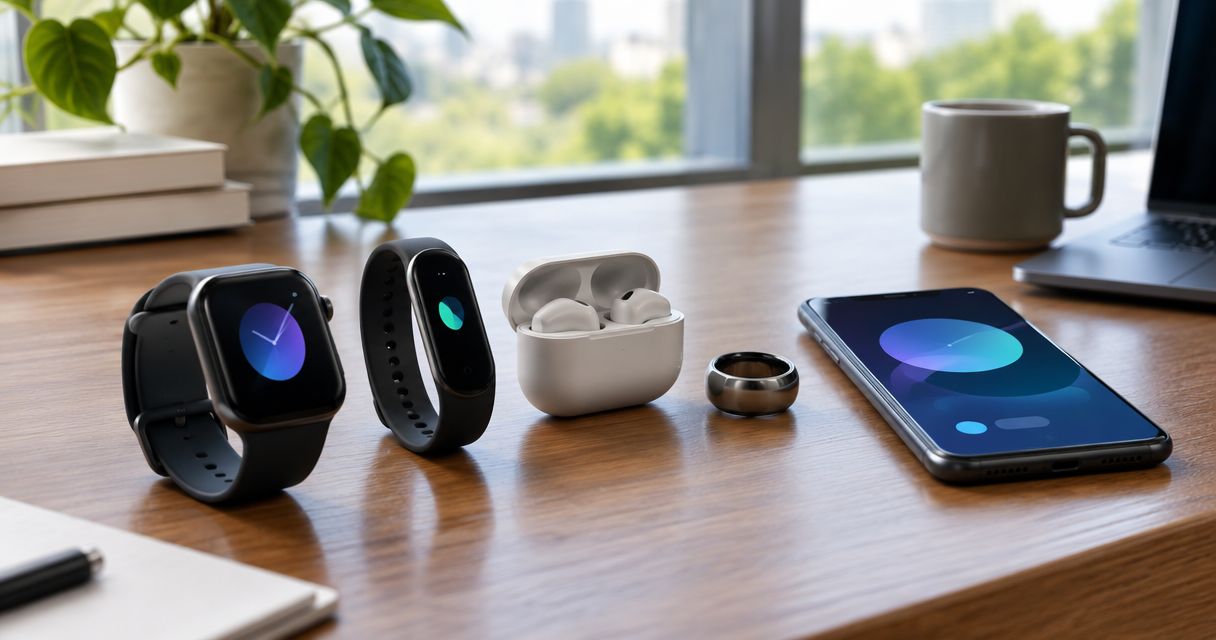
| Rank | Form factor | Best for | Standout battery trait | Key limitation |
|---|---|---|---|---|
| 1 | Screenless clip-on recorder | Meetings, interviews | Larger body, no display | Easy to leave behind |
| 2 | Pendant | All-day wear | Mic and Bluetooth only | Visible, less discreet |
| 3 | Screenless ring | Quiet idea capture | Minimal workload per day | Smallest cell of the group |
| 4 | AI smartwatch | One device for everything | Daily charging is already habit | Display and sensors compete for power |
| 5 | AI pin with display or projector | Hands-free visual answers | None on battery | Highest draw per hour of use |
1. Screenless clip-on recorders: best battery profile for meetings and interviews
A clip-on recorder has the simplest job in this list. It has a microphone, storage, and short-range Bluetooth or a cable for transfer. No screen, no projector, no standalone data connection.
That simplicity buys the biggest cell relative to the workload, because the body is bigger than a ring or a pin face.
Clip-on recorder pros:
- No display draw.
- Room for a larger cell than a ring.
- Sleeps between recordings.
- Predictable use: record, sync, charge.
Clip-on recorder cons:
- Easy to forget on a desk or jacket.
- Looks like a recorder, which changes the room in a sensitive conversation.
Best for: people who record long sessions and want to charge once in a while.
Verdict: Buy if runtime is your only filter. Our screenless wearables guide covers the category in more detail.
2. Pendants: best battery profile for all-day wear
A pendant hangs on a cord, sits near the sternum, and picks up speech well. It carries a microphone and a Bluetooth link to your phone, with the heavy transcription happening elsewhere.
Pendants have more volume than a ring, so more room for a cell. They rank second because the workload is light and the body is roomier than anything you wear on a finger.
Pendant pros:
- Light workload, no display.
- Bigger cell than a ring.
- Stays on the body through a full day.
Pendant cons:
- Visible on the chest, which some people dislike.
- Dependent on a phone for most processing.
Best for: continuous capture through a workday.
Verdict: Buy if you want to wear it without thinking about it.
3. Screenless rings: best for quiet idea capture, battery spec pending
A ring is the hardest place to fit a battery. The cell has to be tiny, so runtime depends entirely on how little the device does.
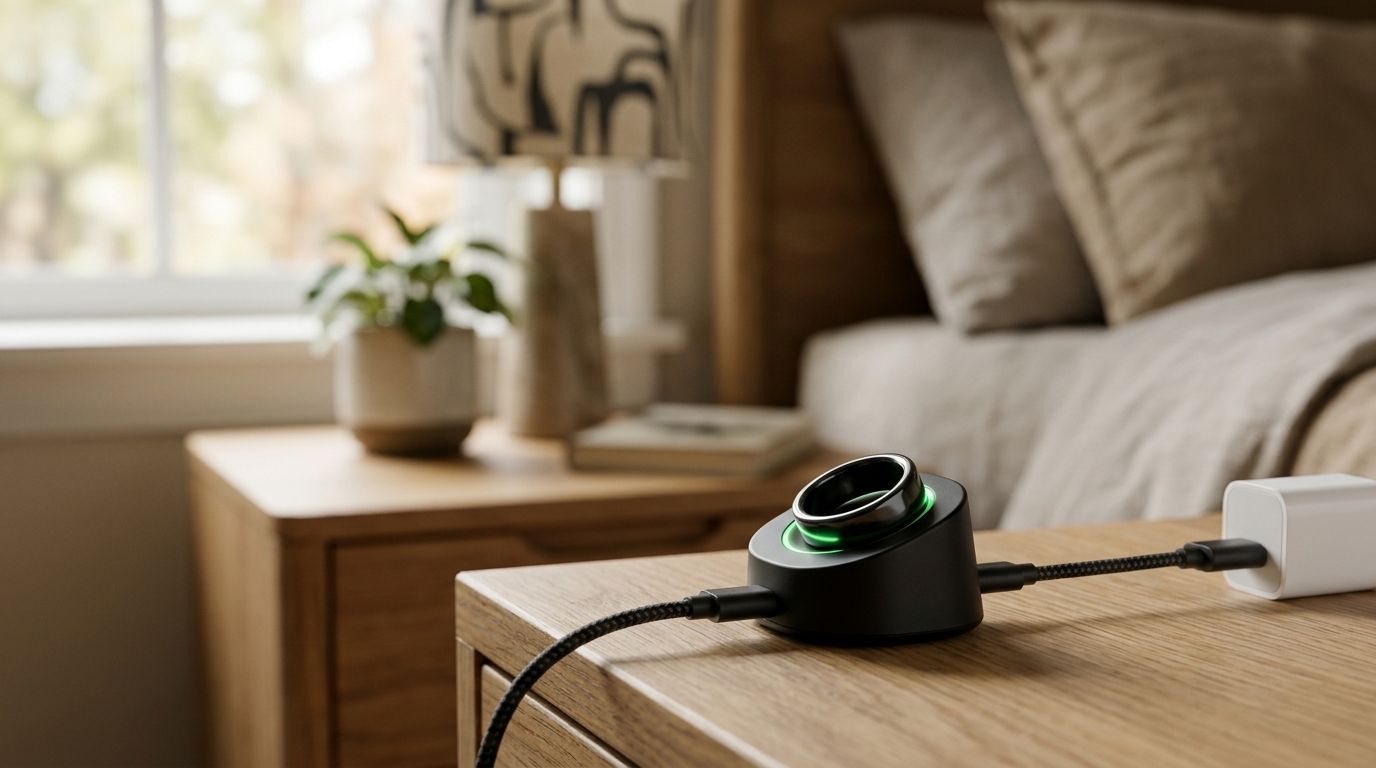
That is why a screenless ring only makes sense when the job is narrow: wake on a spoken thought, capture, sleep. R1 from Present Ring AI is built on that idea. It is a screenless smart ring with a built-in microphone that transcribes spoken ideas and conversations for note-taking.
R1 is in pre-launch. No battery figure has been published for it, so this page does not assign one. Read about the device at Present Ring AI.
R1 pros:
- No screen to power.
- Minimal, single-purpose job: capture the spoken thought.
- Worn like jewelry, so it is on you when the idea shows up.
R1 cons:
- Battery spec not yet published.
- A ring-sized cell is the smallest in this ranking by physical limits.
Best for: people who want presence over features and capture short notes rather than hours of audio.
Verdict: Wait until a recording-hours and charge-time figure is published, then compare it against the criteria above.
4. AI smartwatches: best if you already charge every day
A smartwatch has a display, sensors, and usually its own radios. The AI features sit on top of a device already struggling with runtime.
Its advantage is habit. If you charge a watch nightly, a voice-capture feature adds little extra routine.
Smartwatch pros:
- One device for time, health, and voice notes.
- Charging habit already exists.
Smartwatch cons:
- Display and sensors compete with voice capture for the same cell.
- Capture is a side feature, not the design goal.
Best for: people who want fewer devices, not longer runtime.
Verdict: Hold. Fine as a bundle, poor as a battery pick.
5. AI pins with displays or projectors: weakest battery profile
AI pins try to replace the phone. That means a display or projector, a standalone connection, and on-device work. Each one is a heavy draw, and a pin cannot hold a large cell.
This is the category where runtime complaints cluster, because the design asks the most from the least battery.
AI pin pros:
- Hands-free answers and visual output.
- Works without pulling out a phone.
AI pin cons:
- Highest draw per hour of use.
- Small body, small cell.
Best for: people who want an experiment, not an all-day tool.
Verdict: Skip if battery matters.
“The fewer things a wearable has to power, the longer it lasts between charges.”
How this ranking was built
Each form factor was placed against the six criteria above: display, radios, processing location, cell size, standby behavior, and charging routine. Individual products inside a category will vary, and no battery hour figure is quoted here because none can be sourced for every device in 2026.
When a brand does publish numbers, use this checklist:
- Is the figure continuous recording, standby, or mixed use?
- Does it assume a phone nearby for transcription?
- How long does a full charge take?
- Does the case or cradle add extra charges?
Which AI wearable should you choose in 2026?
Pick by the job, then by battery.
- Long meetings and interviews: a screenless clip-on recorder. Buy.
- Continuous all-day capture: a pendant. Buy.
- Quiet, minimal idea capture: a screenless ring such as R1, once the battery spec is out. Wait.
- One device for everything: an AI smartwatch. Hold.
- Hands-free visual answers: an AI pin. Skip for battery reasons.
If you cannot decide, default to the clip-on recorder for runtime and the ring for presence. Those are the two poles of this ranking in 2026.
FAQ
Which AI wearable has the best battery life in 2026?
Screenless clip-on recorders have the best battery profile in 2026 because they have no display and a larger cell. Pendants come second. Individual products vary, so check the published recording-hours figure.
Do screenless AI wearables last longer than ones with screens?
Yes, as a rule. A display or projector is the largest recurring power draw, so removing it frees the battery for the microphone and Bluetooth link.
What is the battery life of the R1 smart ring?
No battery figure has been published for R1. It is in pre-launch, so wait for an official recording-hours and charge-time number before comparing it.
Are smart rings worse on battery than pendants?
Rings have the smallest cell because of their size. A ring suits short, narrow captures. A pendant has more room for a battery and suits all-day use.
What battery numbers should I look for on an AI wearable?
Look for continuous recording hours, standby days and charge time as three separate figures. A single headline runtime hides how the device behaves in real use.
Does transcription drain the wearable battery?
It depends where transcription runs. If a phone or the cloud does the work, the wearable only powers the microphone and Bluetooth. On-device processing costs more runtime.
One last thing
Battery life matters less the more narrow the job. A device that only listens for a spoken thought and sleeps can get by on a small cell. A device that tries to answer, show and project cannot. Choose the narrowest device that does your job.