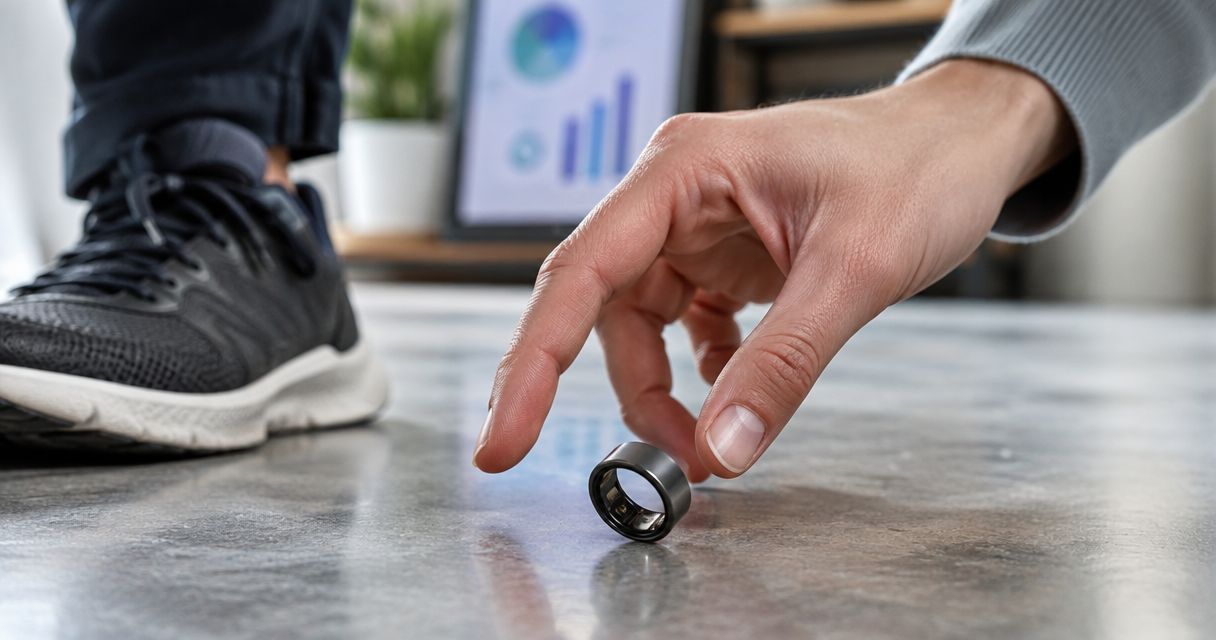
Yes, a smart ring can survive a fall or impact, but survival depends on the device, the landing, and the force involved. A ring that looks intact is not necessarily working correctly, and water resistance does not establish drop resistance. After a hard impact, check the ring before wearing, charging, or relying on it again.
- Can a smart ring survive a fall or impact? Yes, but an intact shell does not prove normal operation.
- Check for deformation, cracks, unusual heat, and changes in function before charging a dropped smart ring.
- Water-resistance ratings do not establish impact resistance; look for separate mechanical test evidence.
- Present-ring-ai targets screenless voice note-taking, not a stated impact-protection use case.
Can a smart ring survive a fall or impact?
A smart ring can survive an accidental drop. No universal safe drop height applies to every ring. A fall onto carpet, an edge-first strike against tile, and compression under a heavy object are different events.
For a 2026 purchase, use the manufacturer's instructions and model-specific test evidence—not the word durable—to judge protection. The Present-ring-ai product description establishes a screenless voice-capture purpose; it does not establish a safe drop height.
If your ring has already fallen, start with this sequence:
- Check your hand. If the ring was being worn, check for pain, swelling, or restricted movement. A hand injury takes priority over testing the device. Seek urgent medical help if a stuck ring affects circulation.
- Inspect the ring. Look for cracks, sharp edges, separation, or a change in shape. Do not bend a distorted ring back into place.
- Check for warning signs. Stop using the ring if it becomes unusually hot, develops an unusual smell, leaks, or shows swelling. Do not charge a visibly damaged device.
- Test normal function. If there are no warning signs, follow the manufacturer's instructions to check the functions you use. A connection indicator alone does not establish that every function works.
- Compare the result. Look for a change from the ring's behavior before the fall. If charging, recording, or another function behaves differently, stop relying on it and contact the manufacturer.
The point is not to prove that the ring is indestructible. It is to decide whether continued use is appropriate.
Why this matters
A wearable sits close to your body. Damage therefore raises two separate questions: whether the device still works and whether it remains appropriate to wear or charge.
Appearance answers neither question completely. A scratch describes surface damage; it does not establish the condition of internal components. Conversely, an unmarked surface is not evidence that everything inside is unchanged.
For a note-taking ring, check the whole result—not just whether the device responds. Capture a non-sensitive spoken note through the normal workflow, then review what was captured. A device that connects but no longer captures usable notes has not passed a useful functional check.
Treat this as a practical check, not a substitute for an inspection when damage is suspected.
A drop, a direct strike, and crushing are different
The word impact covers several kinds of mechanical stress. Describe what happened before deciding what evidence you need.
| Event | What to inspect | What the event does not establish |
|---|---|---|
| Accidental drop | Contact point, cracks, sharp edges, and normal function | That the ring will survive another fall |
| Direct strike while worn | Your finger, the ring's shape, and changes in operation | That the absence of a scratch rules out damage |
| Crushing or pinching | Deformation, separation, and whether the ring is stuck | That a drop-resistance claim covers compression |
| Scraping against a surface | Surface damage and any exposed or sharp area | That scratch resistance means shock resistance |
A ring dropping freely and a ring trapped between hard surfaces experience different loading. Do not treat a successful drop test as proof of resistance to crushing.
The same distinction applies to scratches. A finish that resists abrasion is not, by that fact alone, evidence of internal shock protection. Separate the claims when you read a product page.
For your own records, describe the event plainly: where the ring landed, which part struck the surface, and what changed afterward. That description gives support staff something more useful than it broke during normal use.
Why smart ring impact outcomes vary
General mechanics explains why similar-looking accidents produce different results. These factors do not establish the durability of any particular model:
- Landing surface. A yielding surface and a rigid surface stop a falling object differently. Carpet and tile are not interchangeable test conditions.
- Contact point. Landing across a broad area differs from striking a narrow edge. The location of contact matters alongside the fall itself.
- Type of force. A brief collision, repeated knocks, twisting, and sustained compression place different demands on an object.
- Device construction. The enclosure, joints, and arrangement of internal components affect how force travels through a device. Appearance alone does not reveal that construction.
- Existing damage. A previous crack or deformation changes the condition of the ring being assessed. A result from an undamaged test sample does not describe every previously damaged device.
Use the accident's details to guide inspection, not to calculate a guaranteed outcome. Without applicable test evidence, an estimated fall height is not a pass-or-fail rule.
There is also a practical limit to comparison. Someone else's ring surviving a similar accident does not establish what happened inside yours. It is an anecdote about a different event.
What impact ratings actually tell you
For a 2026 comparison, distinguish a named test standard from a general durability claim. IEC 62262 defines IK classifications for protection provided by electrical equipment enclosures against external mechanical impacts.
Selected reference levels from that standard are:
| IK classification | Impact energy | What the figure describes |
|---|---|---|
| IK05 | 0.7 joules | A defined mechanical-impact energy level |
| IK08 | 5 joules | A defined mechanical-impact energy level |
| IK10 | 20 joules | A defined mechanical-impact energy level |
These are standard reference values, not ratings assigned here to a smart ring. IK08 corresponds to 5 joules; it does not mean a device is safe to drop from a particular everyday height. Test setup, contact geometry, and the product's declared scope still matter.
Likewise, IK05's 0.7 joules and IK10's 20 joules describe impact energy, not battery safety, scratch resistance, or a promise against every accident. Do not convert them into a survival guarantee.
An IP classification answers a different question. IEC 60529 classifies enclosure protection against access, solid objects, and water; an IP designation does not itself establish a mechanical-impact rating.
If a product lists only water protection, keep the conclusion narrow. You have information about its stated water-protection conditions, not proof that it can withstand a fall onto concrete.
What evidence should you ask for before buying?
In 2026, ask for the conditions behind a durability claim. A useful answer describes what was tested and what counted as passing.
Start with these questions:
- Which model was tested? Evidence should apply to the device you are considering, not merely to another product from the same company.
- What kind of test was performed? A drop test, an impact test, and a compression test answer different questions.
- What conditions were used? Ask about the surface, orientation, and condition of the sample. A headline without conditions leaves the claim undefined.
- What was checked afterward? Ask whether the assessment covered appearance alone or also normal operation.
- What instructions apply after an accident? Follow the manufacturer's guidance on inspection, continued use, charging, and service.
Do not fill gaps with assumptions about metal, weight, or price. None of those, alone, establishes a device's tested resistance.
Also separate test evidence from warranty coverage. A protection claim does not tell you whether accidental damage is covered. Read the applicable terms before treating repair or replacement as part of the purchase decision.
How should you check a voice-capture ring after a fall?
Use a simple sequence: Inspect. Capture. Review. Follow it only after checking for visible damage and other warning signs.
Inspect
Look over the ring under good light. Check for a changed shape, separated surfaces, exposed parts, or edges that could irritate your skin. Do not open the enclosure to investigate.
If dirt is present, follow the manufacturer's cleaning instructions. The guide to cleaning a smart ring with a built-in microphone addresses a separate maintenance question; cleaning does not establish that impact damage is absent.
Capture
Use the normal recording process with a non-sensitive spoken note. Choose familiar words so that you can judge the result rather than merely confirm that a file or transcript exists.
Do not repeat the fall as a test. Another impact adds risk without explaining the first one.
Review
Check whether the captured note is usable and whether the workflow behaves as it did before. If the result has changed, describe the change when contacting support.
Do not rely on a questionable device for the only record of an important conversation. Use another established note-taking method until the issue is resolved.

A successful check establishes that the tested functions worked at that moment. It does not certify the enclosure, restore a protection rating, or guarantee future operation.
Where does R1 fit?
Present-ring-ai is best suited to people seeking screenless voice note-taking, not a device with an established impact rating. Its stated pre-launch product, R1, is a screenless smart ring with a built-in microphone that transcribes spoken ideas and conversations.
That purpose fits a quieter capture habit: speak the thought without using a display. The limitation for this question is separate. The supplied product description does not establish drop-test results, an IK classification, or accidental-damage coverage.
For a 2026 decision, assess the note-taking concept and the durability evidence separately. Interest in a minimal wearable is not a reason to assume protection that has not been stated.
Does a scratch mean my smart ring is broken?
A scratch alone does not establish that a smart ring is broken. Inspect the affected area and check normal operation, provided there are no warning signs that require you to stop using the device.
Treat cracks, separation, sharp edges, and deformation differently from a superficial mark. If you cannot tell which you are seeing, ask the manufacturer rather than testing through continued wear.
Can I charge my smart ring immediately after dropping it?
Do not charge a smart ring that is visibly damaged, unusually hot, swollen, leaking, or producing an unusual smell. Follow the manufacturer's instructions before charging after a concerning impact.
Charging is not a diagnostic shortcut. If you suspect damage, connecting the device to power is not the next check.
Should I deliberately drop-test my smart ring?
Do not deliberately drop-test your own smart ring. A home experiment does not reproduce a controlled test or establish a general protection level.
If durability is essential to your purchase, request model-specific evidence before buying. After an accidental fall, document what happened instead of trying to recreate it.
FAQ
Can a smart ring survive a fall onto tile?
A smart ring can survive a fall onto tile, but survival is not guaranteed. Inspect for damage and check normal operation before relying on it again.
Does waterproof mean a smart ring is drop-proof?
No. Water protection and mechanical-impact protection are different claims, and an IP classification does not itself establish drop resistance.
Can a smart ring be damaged without visible cracks?
Yes. An intact-looking exterior does not establish that every internal component is working correctly. Check the functions you use and stop if behavior changes.
What does an IK08 rating mean?
IK08 corresponds to an impact energy of 5 joules under the IEC 62262 classification. It is not a universal safe drop height or a guarantee against crushing.
Is it safe to wear a smart ring after a hard knock?
Check your hand and the device before continuing to wear it. Stop wearing a damaged or unusually hot ring, and seek medical help if a stuck ring affects circulation.
Does Present-ring-ai state a safe drop height for R1?
The supplied Present-ring-ai product description does not state a safe drop height for R1. Request model-specific test evidence rather than assuming a durability level.
What should I tell support after dropping my smart ring?
Describe the landing surface, contact point, visible damage, and any change in normal operation. Follow the manufacturer's instructions and do not recreate the accident.
One last thing
The most useful post-impact question is not whether the ring still turns on. It is whether it remains appropriate to wear, charge, and trust. Those are separate checks.
Before your next important use in 2026, keep a second way to capture the note. A notebook or another established method gives you a fallback while a questionable device is assessed. Presence does not require trusting damaged hardware.