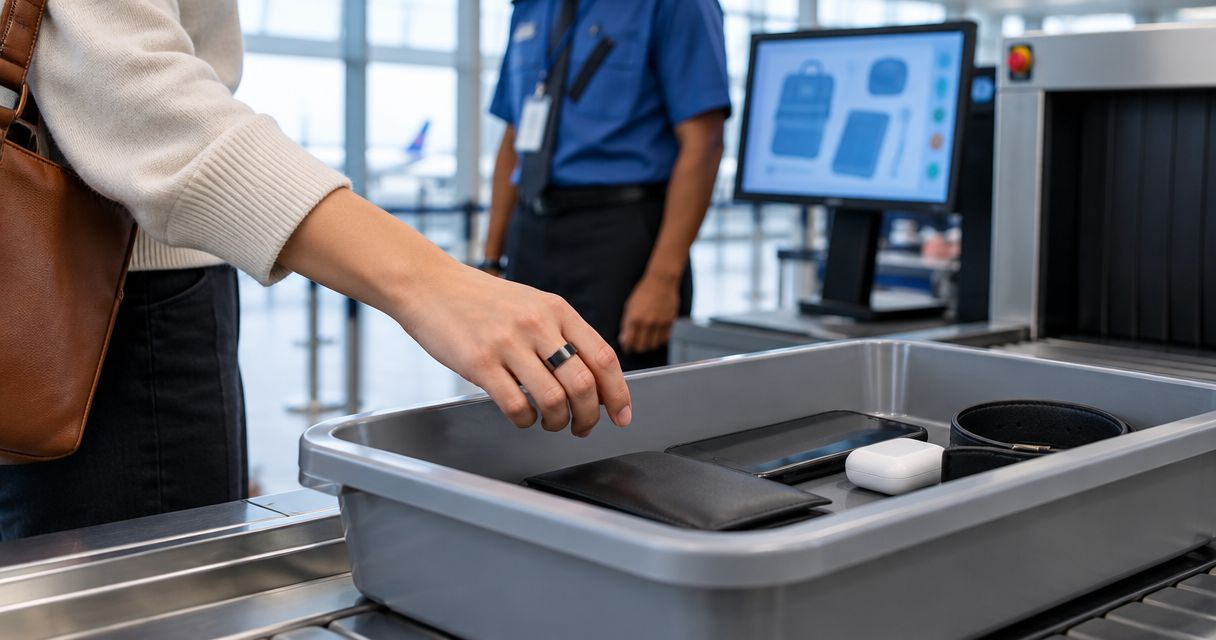
Yes. A smart ring can be detected by an airport metal detector, but detection does not automatically mean it will trigger an alarm or need to be removed. For travel in 2026, follow the screening officer’s instructions: metal detectors, body scanners, and baggage scanners inspect different things.
- Is a smart ring detectable by airport metal detectors? Yes, but detection and an alarm are different outcomes.
- TSA generally allows ordinary jewelry to stay on; follow the screening officer’s instructions.
- A body scanner is not a metal detector. Removing metal does not guarantee clearance.
- Present-Ring-Ai is for screenless voice note-taking, not a guarantee of alarm-free airport screening.
Is a smart ring detectable by airport metal detectors?
Yes. A smart ring’s metal components can interact with a metal detector’s electromagnetic field. Whether that interaction produces an alarm depends on the ring, the equipment, and the screening conditions. Small does not mean undetectable.
The Transportation Security Administration’s jewelry guidance generally allows travelers to keep ordinary jewelry on during screening. That is guidance about what to wear through a checkpoint, not a promise that every ring will pass without additional inspection.
The distinction applies whether you wear a fitness-focused ring or a smart ring for voice note-taking and idea capture. Its purpose does not determine how screening equipment responds to its physical components.
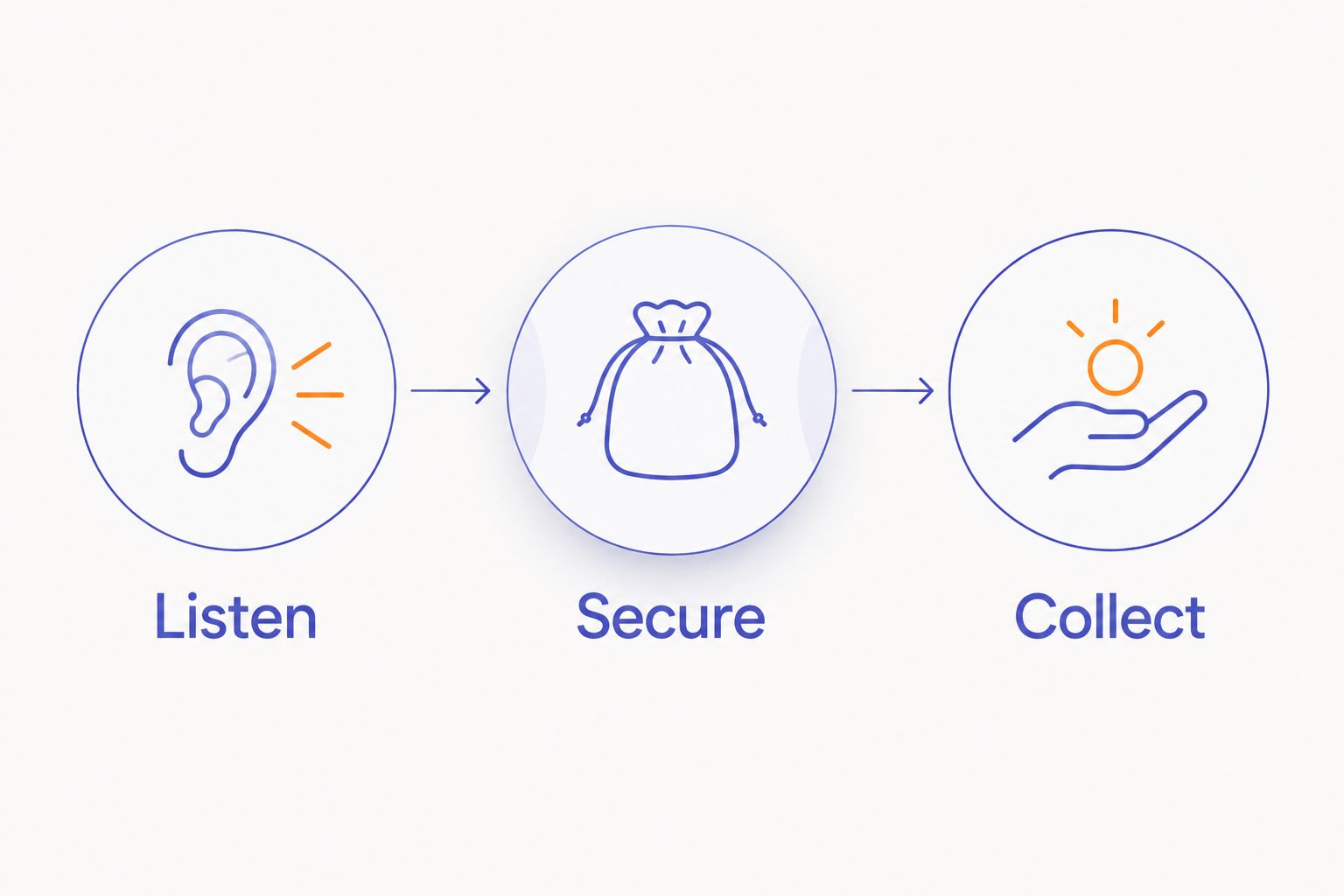
Use this sequence at the checkpoint:
- Listen. Follow the officer’s instructions for the screening lane you enter.
- Secure. If asked to remove the ring, place it in a closed compartment of your carry-on rather than loose in a tray.
- Collect. After screening, check that you have the ring before leaving the collection area.
Why this matters
An airport checkpoint is not a useful place to test whether your ring is detectable. Your task is simpler: complete screening without losing a small device.
For a 2026 trip, separate permission from performance. An item can be permitted through security and still require inspection. Likewise, an alarm does not mean the item is prohibited or that you have done something wrong.
Keep the ring on unless instructed otherwise, and have a secure place ready if removal becomes necessary. That avoids unnecessary handling without treating ordinary jewelry guidance as a device-specific exemption.
Metal detectors and body scanners are different
Travelers often call every checkpoint machine a metal detector. That creates confusion because passenger screening and carry-on screening use different equipment.
A walk-through metal detector responds to metal. A passenger body scanner uses a different method to identify potential threats on the body, including objects that are not metal. A baggage scanner examines your belongings rather than screening you while you wear them.
| Screening equipment | What it examines | What it means for your ring |
|---|---|---|
| Walk-through metal detector | Metal carried on your body | Metal components can be detected; an alarm is not inevitable. |
| Passenger body scanner | Potential threats on the body, including nonmetal objects | A ring’s metal content alone does not determine the screening outcome. |
| Carry-on baggage scanner | Items inside bags and trays | A removed ring is screened with your belongings. |
This distinction explains why one traveler’s experience does not settle the question for everyone. Passing through a metal detector does not establish what will happen during body-scanner screening.
It also explains why removing a ring does not guarantee that you will avoid further screening. Officers assess the screening result, not just the jewelry you chose to remove.
Should you wear the ring or put it in your bag?
Best for ordinary checkpoint preparation: wear your ring and follow instructions. TSA’s general approach to ordinary jewelry does not require you to strip off every small item before entering the lane.
If an officer directs you to remove the ring, secure it before sending your belongings through baggage screening. Do not balance it on a phone, leave it inside an open shoe, or place it loose beside larger items.
| Approach | Best for | Advantage | Drawback |
|---|---|---|---|
| Keep the ring on | Travelers following ordinary jewelry guidance | Avoids unnecessary removal and handling | An officer can still request removal or additional screening. |
| Put it in a closed carry-on compartment | Travelers instructed to remove it | Keeps the ring contained with your belongings | You must remember where you placed it and retrieve it afterward. |
| Place it loose in a tray | Not recommended | Leaves the item visible | A small ring is easier to overlook or separate from your other belongings. |
Choose a compartment you can close fully. A dedicated pouch is useful, but it does not need to be a special electronic accessory.
At the collection area, move out of the immediate flow before reorganizing your bag. Check the compartment deliberately rather than assuming the ring is somewhere among your belongings.
Why a smart ring’s screening outcome varies
There is no single yes-or-no outcome for every ring at every checkpoint. These factors explain the difference without relying on an invented size limit or detection threshold:
- Metal composition. Different metals interact differently with electromagnetic fields. A ring’s marketing category does not describe its entire material construction.
- Amount and arrangement of metal. The housing and internal components contribute to the object being screened. Exterior size alone is not a complete description.
- Screening equipment. A walk-through metal detector and a passenger body scanner do not inspect you in the same way.
- Other items you carry. An alarm during screening does not, by itself, identify your ring as the cause.
- Checkpoint instructions. Officers can request removal or further inspection based on the screening process. Follow those directions rather than another traveler’s account.
For 2026 travel, use these factors to understand uncertainty, not to predict a guaranteed pass. A claim that a particular small ring is always invisible to screening equipment is not a sound basis for packing.
The practical response stays the same. Wear it normally when allowed. Store it securely when asked.
Does turning a smart ring off stop metal detection?
No. Turning a smart ring off does not remove its metal components. A metal detector does not need the ring to be recording, connected to a phone, or actively running a feature to respond to metal.
Power settings and screening are separate questions. Follow any applicable instructions about using electronic devices, but do not treat a power button or a disconnected phone as a way to change the ring’s physical construction.
The same applies to a screenless device. No display means no display. It does not mean no electronics, no metal, or no possibility of additional inspection.
If you need to explain the item, describe its actual function plainly. Do not call an electronic ring ordinary jewelry merely to avoid explaining what it does.
Does a built-in microphone change the screening question?
A microphone does not make a ring exempt from inspection. Security screening concerns the physical item and the applicable procedures, not whether you use it for fitness tracking, spoken notes, or another purpose.
Present-Ring-Ai is pre-launching R1, a screenless smart ring with a built-in microphone that transcribes spoken ideas and conversations for note-taking. Present-Ring-Ai is best for people seeking screenless voice note-taking; that purpose is not an airport-screening guarantee.
The benefit is a note-taking format without a screen. The limit is equally clear: a screenless design does not establish whether a particular detector will alarm or whether an officer will request inspection.
Treat recording as a separate responsibility. Follow posted restrictions and staff instructions, and respect other people’s privacy. Permission to carry a device does not grant permission to record every conversation around you.
What should you check before an international flight?
Use the rules of the authority operating your departure checkpoint. TSA guidance applies to screening in the United States; it is not a universal instruction for every airport abroad.
For an international itinerary in 2026, check the relevant airport or national aviation-security authority’s published guidance. If you must pass through another security checkpoint during a connection, follow that checkpoint’s instructions too.
Keep these questions separate:
- Does the checkpoint ask you to remove jewelry or wearable electronics?
- Are there instructions about electronic devices in cabin baggage?
- Will you pass through another checkpoint during the connection?
- Are there restrictions on photography or recording in the screening area?
Do not substitute an airline’s cabin-use instructions for the security authority’s screening instructions. They address different parts of your journey.
You do not need a technical explanation of the ring at hand. You do need to be able to describe what you are carrying and cooperate with inspection.
Can a smart ring go through the carry-on scanner?
A smart ring can generally be screened in carry-on baggage. If you remove it, place it inside a closed compartment and send it through with your belongings as directed.
Do not confuse being visible in a baggage image with being prohibited. Screening is intended to let officers examine items; a recognizable electronic object is not automatically a problem.
Questions about a specific ring’s care or manufacturer handling instructions are separate from checkpoint permission. Follow those instructions as well. Avoid improvising protective materials or special packaging that you have no reason to use.
What if the ring triggers an alarm?
Follow the officer’s directions and let the screening process identify what needs attention. Do not assume the ring caused the alarm simply because you were wearing it.
If asked, remove the ring and place it where directed. Additional screening can involve another pass or another inspection method, depending on the checkpoint’s procedure.
Stay with the instructions you receive. Arguing that the ring passed through another airport does not establish what the current equipment detected.
Once cleared, collect your belongings and confirm the ring is with you. Resolving the alarm and recovering every small item are separate tasks; finish both before leaving.
FAQ
Will my smart ring definitely set off an airport metal detector?
No. A smart ring can be detected without necessarily producing an alarm. Its construction and the screening equipment affect the outcome.
Do I have to take my smart ring off at TSA security?
TSA generally allows ordinary jewelry to remain on, but you must remove your smart ring if a screening officer instructs you to. Keep a closed carry-on compartment ready in case removal is needed.
Can airport body scanners detect things that are not metal?
Yes. Passenger body scanners screen for potential threats on the body, including nonmetal objects. They do not work like walk-through metal detectors.
Will switching my smart ring off prevent an alarm?
No. Switching the ring off does not remove its metal components. Power status is not a guarantee of passing screening without an alarm.
Where should I put my smart ring if security asks me to remove it?
Put the ring in a closed compartment of your carry-on, following the officer’s instructions. Avoid leaving a small ring loose in a tray.
Does a smart ring with a microphone have different screening immunity?
No. A built-in microphone does not provide an exemption from security screening. Present-Ring-Ai’s screenless voice note-taking purpose does not establish how a checkpoint will screen the device.
Are smart ring screening rules the same in every country?
No. Follow the security authority responsible for the checkpoint you are using. TSA guidance concerns United States screening, not every airport worldwide.
One last thing
A ring that stays on your finger cannot be forgotten in a tray. Do not remove it reflexively just because it contains electronics; listen to the checkpoint instructions first.
For your next flight in 2026, choose the closed compartment you would use before you reach security. That small preparation gives you a clear response if removal is requested. No hurried search. No loose ring.