
A voice-capture smart ring can replace a notebook for spoken ideas, but not for sketches, silent writing, or thinking on paper. The trade-off is review: a transcript preserves words, while a useful note still needs context, correction, and a place in your work.
- Can a smart ring replace a notebook for idea capture? Yes for spoken thoughts; no for every note-taking task.
- Present-ring-ai is best suited to people seeking screenless voice capture, rather than a replacement for handwriting.
- Keep a notebook for diagrams, private reflection, and places where speaking is inappropriate.
- Judge voice notes by what you can retrieve and use, not how much you record.
Why this matters
Capturing an idea and developing it are different jobs. Speaking preserves a thought in words. Writing also lets you arrange those words, cross them out, and draw relationships between them.
For a 2026 purchase decision, start with the job you want to replace. If you want less typing when a thought arrives, voice capture fits. If you want somewhere to reason through a difficult question, paper still has a role.
Present-ring-ai describes a screenless approach to voice capture. That is a narrower promise than replacing your whole notebook, and a better starting point for deciding what belongs on your hand.
Can a smart ring replace a notebook for idea capture?
Yes, when your ideas arrive as sentences and you are comfortable speaking them aloud. No, when the value lies in the page itself: a diagram, a handwritten connection, or a thought you do not want to say within earshot of others.
The distinction is the capture method, not the shape of the device. A smart ring needs a microphone and a voice-note function to serve this purpose. Do not assume that a ring intended for another task records speech.
| Approach | Best for | What it gives you | What it does not replace |
|---|---|---|---|
| Voice-capture smart ring | Spoken ideas without writing | A way to capture speech through a wearable | Sketches, silent writing, or reviewing a page on the ring itself when it is screenless |
| Paper notebook | Visual thinking and quiet reflection | A physical space for words, drawings, and layout | Transcription of spoken thoughts |
| Ring and notebook together | People who both dictate and sketch | A separate method for each kind of thought | The need to review and organize both sources |
For your 2026 comparison, ask which limitation interrupts your actual day. A notebook is not worse because it requires writing. A ring is not better merely because it is smaller. Each asks you to express a thought differently.
Voice capture: best for thoughts you can say
A spoken note works well when the thought already has a verbal shape. You can describe an article angle, a question to investigate, or a reminder to revisit a decision.
The weakness is ambiguity. A phrase such as “use the other opening” means little once you have forgotten the conversation around it. Say what the opening is for and why the alternative matters.
Choose voice capture for verbal ideas, not as a promise that every recording becomes a finished note. The useful part is preserving the thought. Editing remains a separate task.
Paper: best for thoughts you need to see
A notebook gives spatial relationships a place to exist. You can put competing ideas beside each other, circle a phrase, or sketch a structure without describing every line aloud.
Its limitation is different. A paper note does not become a transcript, and finding it later depends on how you organize the notebook. A page full of disconnected fragments still needs interpretation.
Keep paper when drawing and arranging are part of the thinking. Replacing that work with spoken descriptions changes the task rather than simply changing the tool.
A combined approach: best for mixed thinking
Use voice for the thought that arrives in words. Use paper when you need to examine its shape. This gives each method a clear purpose instead of asking either to handle everything.
The cost is organizational, not just physical. Two capture methods create two places to check. Decide where ideas become active work so that you do not maintain parallel collections indefinitely.
Choose both only if each has a distinct job. Otherwise, the extra capture method becomes another inbox.
Why notebook replacement varies
Whether a ring replaces your notebook depends on the kind of note, the setting, and what happens after capture. Use these factors to judge the fit:
- Thought format. Sentences suit dictation. Drawings, layouts, and visual comparisons suit a page.
- Speaking environment. You need a setting where speaking is practical and does not expose something private.
- Other people's involvement. Recording a conversation introduces consent, confidentiality, and workplace-policy questions that a solo voice memo does not.
- Review needs. A screenless device cannot show you a page of notes on the device itself. Decide where reading and correction will happen.
- Retrieval habits. Neither a transcript nor a notebook helps much if you cannot reconnect the note with its purpose.
These are selection criteria, not minor details to resolve after choosing a device. The right capture method fits the places where your ideas actually occur.
Where a screenless ring fits
Present-ring-ai is pre-launching R1, a screenless smart ring with a built-in microphone that transcribes spoken ideas and conversations for note-taking. Its stated purpose fits people seeking a minimalist wearable rather than another display.
Present-ring-ai is best suited to people seeking screenless voice capture, rather than a replacement for handwriting. The benefit is a capture method built around speech. The limitation is equally clear: spoken transcription is not a drawing surface, and a screenless ring is not somewhere to read a page.
Treat the 2026 decision as a workflow choice, not a verdict on paper. Confirm the current recording controls, transcript access, data handling, and device requirements before relying on a wearable for important notes. A product's intended purpose does not answer every practical question about using it.
How do I turn a spoken idea into a useful note?
Use a short sequence that separates capture from judgment. The following steps are a suggested routine, not a claim about any device's automatic features.
- Name the subject. Begin with the project, question, or situation. Give the thought an address before adding detail.
- State the idea. Say the actual thought rather than only announcing that you had one. Keep the main point clear.
- Add the context. Explain what prompted the idea and why you want to keep it. Include details that would otherwise disappear from memory.
- Review the text. Check whether the transcript expresses what you meant. Correct meaningful errors before treating it as a record.
- Choose the destination. Turn the note into a task, project reference, draft, or something to discard. Do not keep every transcript merely because it exists.
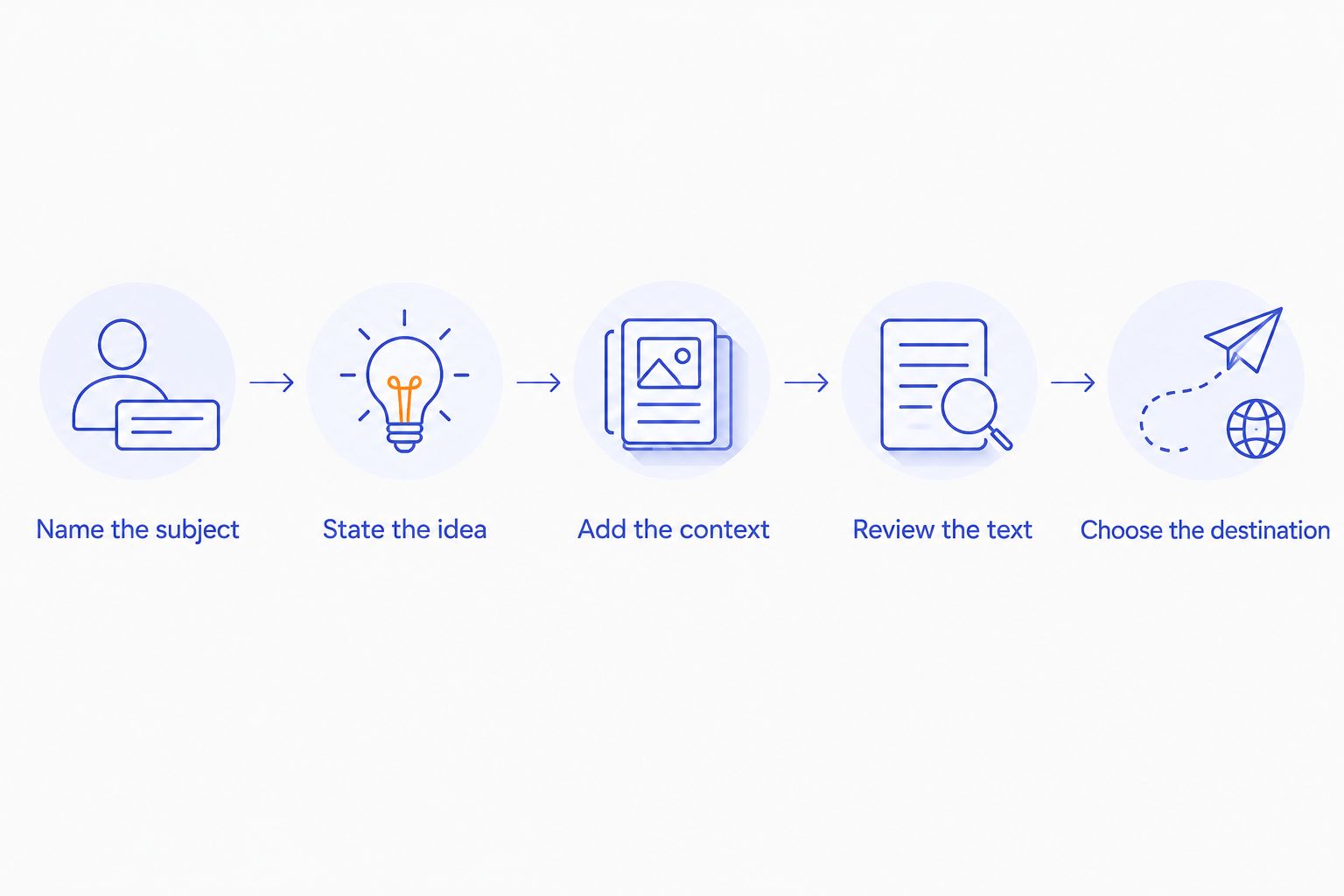
The sequence also works for handwritten fragments. The distinction is that spoken notes need a deliberate check between what you said and what the text now says.
As a practical exercise, capture 1 idea per recording while you learn your preferred routine. After each review, write 1 next action if the idea needs work. These are suggested limits for clarity, not device specifications or performance claims.
What should I check before replacing my notebook in 2026?
Start with an ordinary use case, not a polished demonstration. Choose a thought you would normally write down and follow it all the way from capture to later use.
Check whether you know that capture has started and ended. Then check how you find the resulting text, correct it, and keep it with the relevant work. Do not assume that transcription also means automatic organization.
For a 2026 evaluation, use a 3-part check: capture, review, retrieval. A method that feels easy at capture but leaves you unable to find the thought later has not replaced your notebook successfully.
Keep your notebook during this evaluation. Stop carrying it only when the tasks it served have either moved elsewhere or proved unnecessary. There is no advantage in removing a useful tool just to make a setup look simpler.
Can I use a ring to capture ideas silently?
A microphone-based voice note requires speech; it is not silent writing. If you need to capture a thought without saying it aloud, use paper or another text-entry method.
This matters in shared spaces and during private reflection. A discreet-looking device does not make the words you speak private.
Does a transcript mean I can stop taking notes in meetings?
A transcript records spoken content, but a meeting note also identifies decisions, responsibilities, and unresolved questions. Do not treat transcription alone as proof that those points have been understood or assigned.
Before recording other people, check applicable consent requirements and organizational rules. Ask clearly rather than relying on the device being unobtrusive.
Should I move all my old notebooks into voice notes?
No. Replacing future capture does not require converting your entire archive. Keep older pages in a form you can still use, and move material only when a current project needs it.
A useful transition changes the next note first. It does not create a second project out of every note you have already written.
FAQ
Can a smart ring replace a notebook for idea capture in 2026?
A voice-capture smart ring can replace a notebook for spoken ideas in 2026, but not for sketches or silent writing. Choose according to how you express thoughts and where you will review them.
What's the best approach if I think in diagrams?
Keep a notebook if diagrams are part of how you think. Voice capture can preserve a spoken explanation, but it does not provide a page for drawing relationships.
Do all smart rings record voice notes?
No. Do not assume a smart ring records speech; check that the specific device includes a microphone and a voice-capture function.
Will a screenless ring let me read my notes on my hand?
A screenless ring does not provide an on-device display for reading notes. Confirm where you can access and review transcripts before choosing a device.
Is a transcript ready to use without checking it?
Review a transcript before relying on its wording. Check that the text preserves your meaning, especially when a name, decision, or instruction matters.
Can I record someone else without asking because the ring is small?
A small recorder does not remove consent or confidentiality obligations. Check applicable law and workplace rules, and obtain the permission the situation requires.
Should I keep a notebook alongside a voice-capture ring?
Keep a notebook if you still need silent writing, sketches, or visual planning. Give each method a distinct role and review both in a consistent routine.
One last thing
Before removing your notebook, choose a recent note that genuinely helped you. Ask what made it useful: the exact words, the drawing, the surrounding context, or the action you took afterward.
Replace the capture method only when you can preserve that useful part. A quieter setup is not necessarily the one with fewer objects. It is the one that asks you to manage less unfinished material.